AI for Incident Response: Predictive Runbooks and Automated Root-Cause Hypotheses
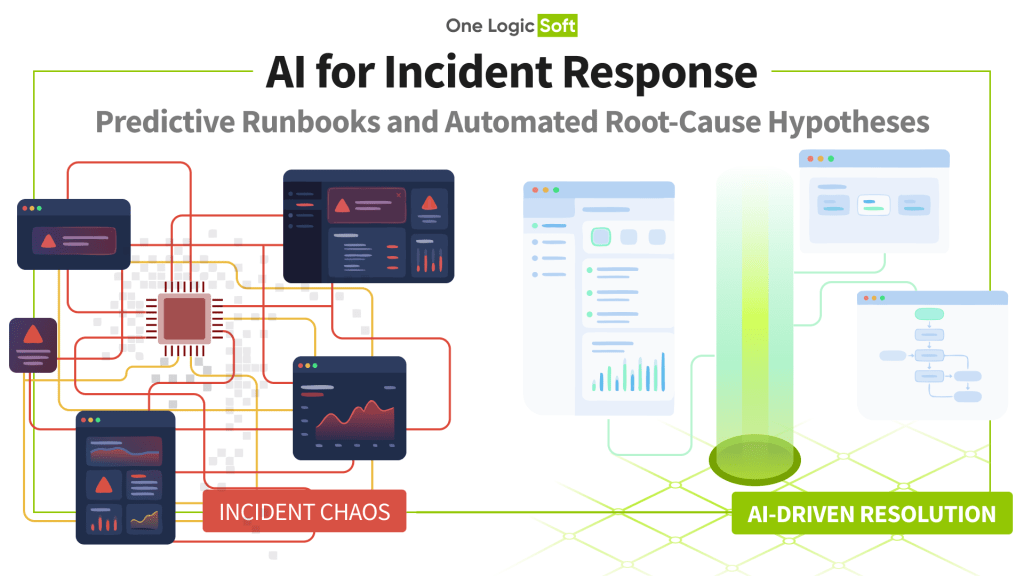
Why AI Matters for Incident Response
Distributed environments create incidents through chains of small anomalies rather than a single failure. In logistics, retail, finance and high-load consumer platforms, these anomalies often span services, queues, caches, third-party integrations, CI/CD pipelines and multi-cloud deployments.
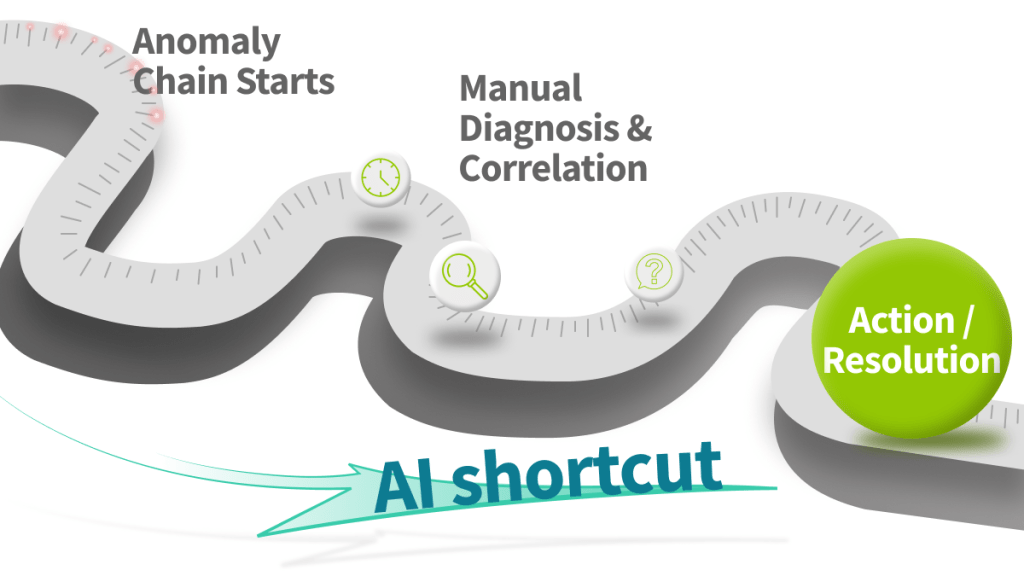
The most time-consuming part of any incident occurs in the first minutes, when teams must:
- gather fragmented telemetry,
- identify dependency paths,
- correlate recent changes,
- understand how the situation may escalate.
AI compresses this diagnostic window. Instead of manual correlation across dashboards and logs, teams receive early predictive signals, adaptive runbooks and structured root-cause hypotheses based on real data.
Predictive Early Warning
Modern AI models learn from months of logs, metrics, traces, configuration changes and deployment history. Their value appears before the system breaks.
Typical early predictors include:
- latency drift between services that usually move in sync,
- unusual traffic ratios across nodes or regions,
- cache invalidation behaviour that deviates from normal patterns,
- error clusters across unrelated components,
- queue depth oscillations that historically preceded major outages.
Top engineering teams report that more than 70-80 percent of major incidents are preceded by such weak signals. AI detects these correlations consistently, long before humans would escalate.

Predictive Runbooks: From Static Pages to Adaptive Guidance
Static Confluence runbooks rarely match real production conditions. They become outdated within weeks, and they don’t reflect recent architectural changes.
Predictive runbooks change this dynamic.
They ingest:
- live metrics,
- current logs and traces,
- deployment diffs,
- traffic distribution,
- infrastructure events.
Then they generate a context-aware sequence of steps relevant to the current incident. The runbook updates itself as new signals arrive.
Typical actions include:
- isolating the first degrading service in a dependency chain,
- inspecting the most recent deployment affecting that path,
- comparing current queue behaviour with historical P95 patterns,
- validating cache tiers affected by the last commit,
- checking upstream timeouts likely to cascade next.
This guidance reduces context switching and helps even less experienced engineers follow a solid diagnostic path.
Why Predictive Runbooks Work
- They adapt to real conditions instead of static assumptions.
- They merge tribal knowledge across engineering teams.
- They reduce the cognitive load on on-call engineers.
- They create consistency between regions, shifts and teams.
Automated Root-Cause Hypotheses
Root-cause analysis often consumes half the incident duration. AI lowers this cost by generating structured hypotheses based on correlation analysis:
- configuration drift across environments,
- behavioural anomalies in dependent services,
- changes in error patterns or latency distributions,
- recent commits mapped to affected modules,
- infrastructure-level anomalies (CPU saturation, node replacement, pod churn),
- historical incidents with similar signatures.
Each hypothesis includes:
- a probable cause,
- a supporting evidence chain,
- a confidence score,
- recommended next checks.
Engineers stay fully in control, but the search field becomes drastically smaller.
Practical MTTR Reductions: Real Results Across the Industry
AI-driven incident response is no longer theoretical. Between 2024 and 2025, multiple companies reported measurable improvements:
| Company / Sector | AI Capability | MTTR Reduction | Notes |
| Meta | ML-based alert correlation & automated triage | 50% reduction for critical alerts | Billions of daily events processed without increased engineer fatigue |
| Chipotle (via BigPanda) | GenAI correlation & incident ticketing | 50% overall | Reduced noisy alert volume, accelerated root-cause identification |
| Unnamed SaaS (Rootly + PagerDuty) | Predictive failure detection, pod auto-recovery | From 20 min to <3 min for K8s failures | 200+ alerts collapsed into one actionable ticket |
| Large Banks (Cutover Respond) | AI agents assisting in runbook execution | 50-70% faster resolution for major incidents | Improved multi-team coordination |
| AI-enabled SOC (Torq HyperSOC) | Autonomous anomaly detection & remediation | From hours to under 2 minutes | Also reduced false positives handling time from 20+ minutes to 3 minutes |
These results align with broader market research: Gartner estimates that AI-assisted incident response reduces MTTR by 30-50 percent on average in complex systems.
Challenges and Engineering Realities
Even though the benefits are clear, two issues remain complex in real-world organizations.
1. Maintaining Accurate Dependency Graphs
Up-to-date service maps and change-to-service relationships are notoriously difficult.
Many companies still struggle to track:
- internal APIs that change without documentation,
- shadow dependencies,
- side effects hidden inside shared libraries,
- evolving infrastructure (autoscaling, blue/green, canaries).
AI can infer relationships from runtime telemetry, but human oversight and governance are still required.
2. Avoiding Predictive Alert Fatigue
Predictive alerts can help, but false positives erode trust quickly.
AI must provide:
- confidence levels,
- clear explanations of “why this matters now”,
- suppression rules for patterns proven non-critical,
- alignment with human decision-making rather than replacing it.
Teams adopt predictive systems successfully only when these elements are transparent.
How AI Fits Into the On-Call Workflow
A typical AI-assisted workflow looks like this:
- An alert fires.
- AI correlates changes, telemetry and historical incident patterns.
- A predicted escalation path appears with probability scores.
- A dynamic runbook is generated.
- Automated hypotheses narrow the root-cause search.
- Engineers validate and execute.
- The system learns from the final resolution for future accuracy.
Integration With One Logic Soft Engineering Practices
One Logic Soft builds AI-assisted monitoring and incident response layers into client infrastructures across logistics, retail, e-commerce, fintech and automotive sectors.
The AI stack integrates with:
- Prometheus, Grafana, CloudWatch, Azure Monitor,
- OpenTelemetry and Jaeger,
- Elasticsearch/OpenSearch,
- GitLab CI, GitHub Actions, Jenkins,
- Kubernetes, microservices dependency graphs,
- infrastructure-as-code repositories.
This model works without replacing existing operational workflows.
Engineering Outcomes Across Projects
In practice, AI-enhanced incident response provides measurable improvements:
- faster detection of cascading failures,
- more stable deployments during traffic peaks,
- fewer escalations to senior engineers,
- improved consistency of on-call performance across regions,
- lower operational load for complex systems,
- reduced repetitive diagnostic tasks.
For high-load businesses, these gains translate into fewer outages, higher SLA compliance and more predictable operations.
Table: Classic vs AI-Assisted Incident Response
| Aspect | Classic Approach | AI-Assisted Approach |
| Early detection | Manual observation | Predictive pattern recognition |
| Runbooks | Static, often outdated | Adaptive and real-time |
| Root-cause analysis | Slow and experience-dependent | Structured hypotheses with evidence chains |
| MTTR | Highly variable | 30-70% reduction |
| Alert noise | High fatigue | Correlated and deduplicated |
| Cross-shift consistency | Depends on individuals | Standardised workflow |
FAQ
Does AI replace on-call engineers?
No. AI accelerates diagnostics and correlation, but engineers make final decisions.
Can predictive systems produce false positives?
Yes, which is why confidence scoring, suppression rules and human validation remain essential.
How much data is required to train models?
Several months of logs, metrics, traces and deployment history are usually enough to begin. Models improve continuously.
Is this approach effective for mid-sized systems?
Yes. Even smaller architectures generate enough telemetry for pattern analysis.
Can AI integrate with existing DevOps tooling?
Yes. AI layers sit on top of monitoring, CI/CD and cloud platforms already in use.
Have a project in mind?
Let's chat
Your request has been accepted!
In the near future, our manager will contact you.
Have a project to discuss?

Have a partnership in mind?