Custom Software Pricing in 2026: Scope, Team Setup, and Hidden Work
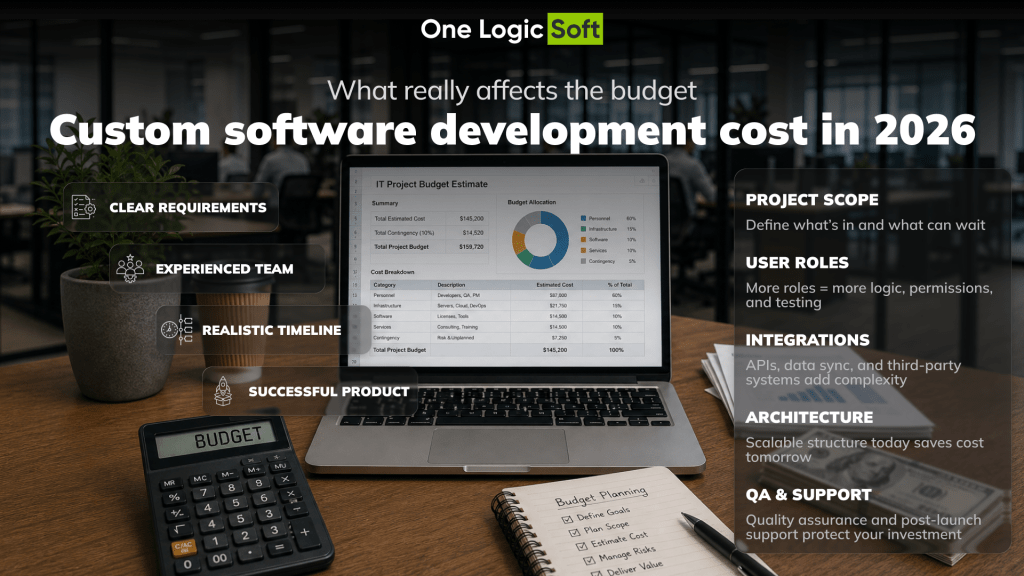
Custom software development cost in 2026 is rarely defined by an hourly rate alone. The real budget comes from product decisions: what the first release includes, how the business process works, which systems need to connect, how data moves, and what level of quality the product needs after launch.
Two companies can request similar apps and receive very different estimates. One may need a simple customer flow. Another may need user permissions, admin tools, integrations, reports, data migration, mobile testing, and long-term support. On paper, both projects may sound like “an app.” In delivery, they are completely different investments.
A price range without context can mislead. McKinsey’s long-running benchmark on large IT projects found that they ran 45% over budget, 7% over time, and delivered 56% less value than predicted. The useful lesson is clear: cost control starts before the first development sprint. See the McKinsey report on large-scale IT projects.
For companies planning custom software development, the better question is not “How much does software cost?” A better question is: what assumptions are included in the estimate, and what risks are still open?
Why Custom Software Estimates Vary So Much
A software project estimate is built from assumptions. If the assumptions are vague, the budget can look smaller at the start and grow later. If they are clear, the estimate may look higher at first, but it gives the team a safer path to delivery.
The same request can mean very different work in practice:
- A small MVP with limited workflows
- A mobile app with backend, payments, notifications, and an admin panel
- A B2B platform with several roles and approval rules
- A logistics system with mapping, routing, documents, and external tools
- A healthcare booking platform with reminders, permissions, and reporting
- A commerce platform with catalogs, regional pricing, CRM, ERP, and payment logic
The feature list is only the visible layer. The real estimate sits behind user flows, data changes, third-party systems, testing needs, release planning, and ownership after launch.
Main Software Cost Factors in 2026
Many price guides reduce software development cost to scope, technology stack, team location, integrations, and support. These factors are useful, but only when they are connected to real product decisions. A better estimate explains what the team is building, how the product works inside the business, which systems it touches, and what level of reliability the launch requires.
The easiest way to read a software estimate is to separate visible features from hidden work. Visible features are the screens users see. Hidden work includes business rules, permissions, data structure, integration behavior, testing, deployment, and future changes. This hidden layer often decides whether the first estimate stays realistic.
Scope and Release Decisions
Project scope is not just a list of screens. It is the set of decisions behind the first release. A feature that sounds small in a call can grow when it needs statuses, notifications, reports, exports, admin control, error handling, and several access levels.
A realistic first-release scope should answer a few direct questions:
- What business result should the product create?
- Which user action matters most in the first version?
- Which features belong to release one?
- Which features can wait without weakening the launch?
- What does the internal team need to manage after release?
- How will the team confirm that the feature is complete?
For early-stage products, project planning for web and mobile apps helps turn a rough idea into a first-release scope that can be estimated with fewer guesses. If the technical idea still carries uncertainty, PoC and MVP planning can separate feasibility testing from first-release delivery.
Business Logic, User Roles, and Permissions
User roles often look simple during early estimation. A client may say the product needs an admin, a manager, and a customer account. In practice, each role can change what the system shows, what data can be edited, which actions need approval, and what needs to be logged.
This is where interface work turns into business logic. A customer flow may need manager approval. A manager action may trigger a notification. An admin change may affect pricing, reports, or user access. A support team may need activity history to resolve issues after launch.
The cost grows when these rules are not defined early. The team then has to make decisions during development, rebuild flows, or add missing permissions after testing begins. For products with several access levels, role-based QA is part of the estimate, not an optional extra.
Integrations, Data, and Architecture
Integrations are a common reason software estimates grow after the first discussion. Connecting to a CRM, ERP, POS, payment gateway, booking system, warehouse platform, map service, or email tool is rarely just a connector. The team needs to know which system owns the data, how fields match, what happens when sync fails, and whether safe test access is available.
This is why integration project timeline risks should be discussed before estimation. The development task may be clear, but the budget risk often sits in data quality, ownership, access, and edge cases.
Architecture belongs to the same conversation. The technology stack affects hiring, speed, maintainability, infrastructure, security, and future feature work. A small internal tool can work with a simple structure. A product expected to grow needs a stronger technical base: clean database design, stable backend logic, permission rules, deployment process, monitoring, and room for future integrations.
The goal is not to build too much too early. The goal is to avoid a first version that becomes expensive to change once the business starts depending on it.
Team, QA, Release, and Support
Two estimates can differ because the teams behind them are not the same. One vendor may calculate only development hours. Another may include business analysis, UX, architecture, QA, project management, DevOps, and support planning.
A smaller team can fit a focused MVP. A complex product needs more roles because it carries more risk points. The question is not whether the team is large or small. The question is whether the estimate includes the people needed to deliver the product safely.
QA is part of that answer. It is not a final check after coding. It proves that the product can handle real users, business rules, external systems, device differences, admin actions, and edge cases. Skipping QA can make the first estimate look smaller, but the cost often returns through bugs, manual fixes, user complaints, and delayed releases.
Release and support matter as well. The team needs deployment steps, environment setup, monitoring, backups, and a plan for urgent fixes. After launch, support may include bug fixing, performance checks, usability changes, analytics review, and user feedback processing.
The real custom software development cost is not the cost of writing code once. It is the cost of building a product that can be launched, tested, used, changed, and supported without turning every next step into rework.
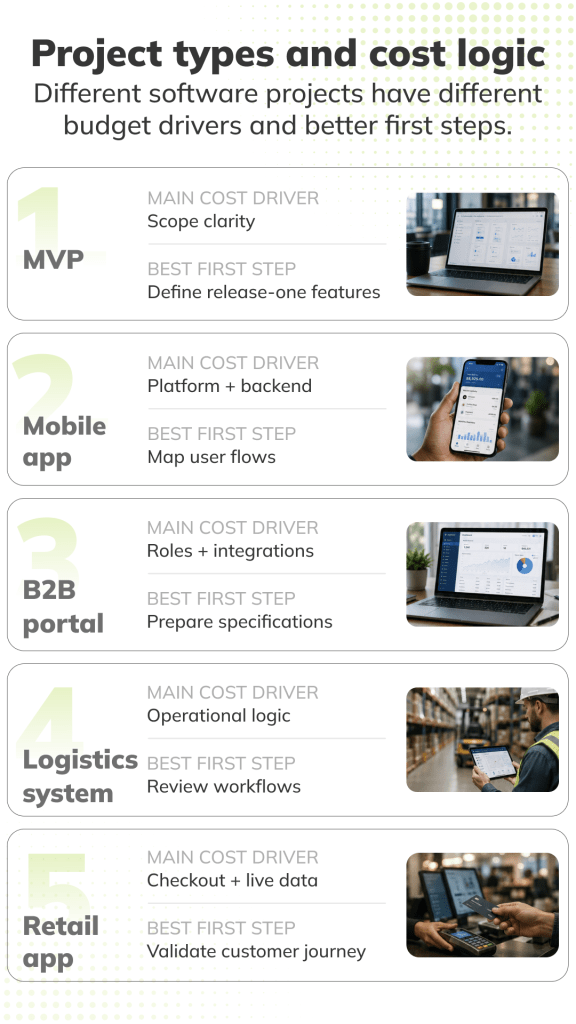
Project Type, Cost Logic, and Best First Step
| Project type | Cost logic | Main budget drivers | Best first step |
| MVP for a new product | Cost depends on how tightly the first release is defined | Core features, backend needs, UX, admin panel, QA | Define release-one scope and success criteria |
| Mobile app | App development cost depends on platform choice, backend, devices, and store release needs | iOS, Android, cross-platform stack, push notifications, payments, QA devices | Map user flows and backend requirements |
| B2B portal | Budget depends on roles, permissions, pricing logic, and integrations | User groups, approvals, CRM, ERP, catalogs, reporting | Prepare a project specification |
| Logistics system | Cost grows with operational logic, routing, documents, and external systems | 1C, maps, shipment statuses, document generation, admin workflows | Review a real logistics example like the UVK order management system |
| Retail mobile product | Cost depends on checkout logic, scanning, loyalty, payment, and live data | Barcode scanning, payments, loyalty system, cart sync, error states | Study flow complexity through the mobile self-checkout MVP |
| Existing product rebuild | Cost depends on audit findings, technical debt, migration, and feature priorities | Code quality, database structure, missing documentation, risk cleanup | Run a technical and product review before estimation |
Software Development Pricing Models and Budget Control
The pricing model affects how budget risk is shared between the client and the development team. It does not remove risk by itself.
The most common software development cooperation models are:
- Fixed Price: fits projects with clear scope, requirements, acceptance criteria, and delivery limits
- Time and Material: fits products that need flexibility, phased discovery, changing priorities, and ongoing technical decisions
- Dedicated Team: fits long-term product work where the client needs stable capacity, domain knowledge, and continuous delivery
The model needs to match the project stage. Fixed Price can look safer at first, but it requires strong preparation. If scope is unclear, the estimate will include buffers, exclusions, or later change requests. Time and Material gives more flexibility, but it needs active backlog control and transparent reporting.
For a deeper comparison, the One Logic Soft article on Fixed Price vs Time & Material explains how each model changes budget predictability, flexibility, and client involvement.
A pricing model is not a shortcut. Budget control comes from defined scope, visible risks, clear milestones, and shared decision rules.
Hidden Costs Companies Often Miss
Hidden costs usually appear when the estimate covers visible features but leaves operational decisions open. These costs are not always technical surprises. In many cases, they come from data, approvals, business rules, and post-release needs that were not defined early enough.
Common budget leaks include:
- Messy source data: duplicate records, missing fields, outdated spreadsheets, and inconsistent formats
- Internal tools: admin panels, dashboards, role management, exports, logs, and content controls
- Vendor dependency: waiting for API access, payment gateway approval, ERP documentation, or third-party sandbox accounts
- Edge-case logic: refunds, failed syncs, cancelled orders, expired sessions, duplicate bookings, and manual overrides
- Security and access control: permissions, audit logs, sensitive data handling, backups, and recovery rules
- Release preparation: staging environments, deployment steps, rollback planning, monitoring, and production checks
- After-launch backlog: bug fixes, small usability changes, analytics review, and user feedback from the first real users
These costs are easier to control when they are named before development. Some belong in the first release. Some can move to later phases. The risky option is leaving them invisible until the product is already being built.
What to Prepare Before Asking for a Software Project Estimate
Before asking for a software project estimate, prepare enough context for the team to evaluate scope, risk, and delivery model. A short feature idea is rarely enough for a reliable budget.
- Describe the business goal
Explain what the product needs to change in the business: fewer manual tasks, faster order processing, cleaner booking flow, better reporting, higher conversion, lower support load, or stronger internal control. - Define the main users
List user types, permissions, and the actions each role needs to perform. - Prepare core workflows
Write the main flows step by step. Focus on real actions, not just screen names. - List required integrations
Add every system that needs to connect: CRM, ERP, payment gateway, warehouse system, POS, map service, email tool, analytics, booking platform. - Separate first release from later phases
Mark must-have features and future features. This helps estimate the first budget without losing the long-term roadmap. - Share existing materials
Send designs, wireframes, process documents, API documentation, old product access, spreadsheets, reports, and internal notes. - Clarify non-functional needs
Add performance, security, compliance, data storage, backups, browser support, mobile devices, and hosting expectations. - Ask what is excluded from the estimate
A reliable estimate should show assumptions, exclusions, risks, required client-side input, and conditions that may change the budget. - Define decision makers
Budget grows when approvals are unclear. Name who approves scope, design, technical decisions, and release priorities.
How to Judge Whether a Software Estimate Is Reliable
A useful estimate does not only show a number. It explains how the number was built. This makes it easier for founders, CTOs, product owners, and finance teams to compare vendors without choosing the lowest price by mistake.
A reliable software project estimate should include:
- Scope logic: what is included in the first release and what is excluded
- Team structure: which roles are included and why they are needed
- Milestones: how delivery is split into visible stages
- Assumptions: what the estimate depends on
- Risk notes: what can change the budget or timeline
- Client inputs: what the client needs to provide before work can move forward
- Testing scope: what QA covers before release
- Support expectations: what happens after launch
This section gives the reader a practical way to check vendor proposals before signing a contract. It also shifts the decision from “Which vendor is cheaper?” to “Which estimate is clearer, safer, and easier to manage?”
How One Logic Soft Approaches Software Cost Estimation
One Logic Soft treats estimation as a planning process, not a number taken from a short call. The team starts with the business goal, then checks product logic, technical constraints, delivery stages, and the model of cooperation.
A practical estimation process can include:
- Business goal review
- Workflow mapping
- Feature grouping
- Technical review
- Integration check
- Risk list
- Milestone roadmap
- QA planning
- Team structure
- Cooperation model selection
One Logic Soft works with custom web and mobile applications, integrations, scalable systems, and production-ready releases across B2B and B2C projects. The company presents 3 offices across Europe, 60+ people on staff, 7 years of experience, and 87% of clients from Europe on its service pages.
This approach fits products with real operational weight: logistics flows, retail checkout, booking systems, B2B commerce, internal platforms, reporting tools, and long-term product ownership.
When One Logic Soft Fits the Project
One Logic Soft fits projects where the product is tied to business operations, not only interface delivery. This includes platforms with role-based access, operational rules, admin tools, reporting, external systems, release requirements, and long-term product ownership.
The strongest fit is a project where the client needs to turn a rough idea into a realistic scope, roadmap, estimate, and delivery model before full development starts.
If your team is preparing a new product, rebuilding an existing system, expanding an MVP, or planning a complex integration project, share the project context with One Logic Soft. A clearer estimate starts with clearer assumptions.
FAQ
Why do custom software estimates change after the first call?
Early calls often cover visible features, but not enough operational logic. The estimate can change when the team discovers extra user roles, approval flows, integrations, data migration, reporting, or release requirements.
What should a software project estimate include?
A useful estimate should include scope, assumptions, team roles, milestones, exclusions, risks, QA coverage, client-side inputs, and post-launch expectations. Without these items, the price may look clear but still carry hidden uncertainty.
Is the cheapest software estimate usually the best option?
Not usually. A lower estimate may exclude QA, project management, documentation, DevOps, integration testing, or support. The better comparison is not price alone, but what each vendor includes in the delivery plan.
When is a PoC better than an MVP?
A PoC fits when the team needs to prove that the technical idea can work. An MVP fits when the team already knows the product can be built and wants to test real users, workflows, and market response.
How does project specification affect the budget?
A project specification replaces guessing with defined scope, user flows, feature logic, integrations, milestones, risks, and acceptance criteria. It helps the development team estimate work with fewer assumptions.
Can One Logic Soft estimate an unfinished product?
Yes. An unfinished product can be reviewed through product analysis, technical audit, backlog cleanup, risk review, and phased planning. This gives the client a clearer picture of what can be reused, rebuilt, fixed, or postponed.
What affects app development cost the most?
App development cost is shaped by platform choice, backend complexity, user roles, integrations, device testing, push notifications, payments, admin tools, and release requirements. A simple interface can still need a serious backend.


Have a project in mind?
Let's chat
Your request has been accepted!
In the near future, our manager will contact you.
Have a project to discuss?

Have a partnership in mind?