PoC vs MVP: Why You Need Both and How They Save Budgets
In technology projects, most failures do not come from bad ideas but from untested assumptions. Many companies rush from concept to code without confirming whether the idea is technically possible or whether the market even wants it.
This is where PoC (Proof of Concept) and MVP (Minimum Viable Product) come in. The first confirms that the idea can be built. The second proves that people actually need it. Together they form a disciplined path from uncertainty to a validated product.
What Is PoC
A Proof of Concept is a short and focused experiment designed to confirm technical feasibility. It answers the question: Can this idea actually work in practice?
The PoC phase is not about visuals, UX, or scalability. It is about verifying whether the core technology, algorithm, or system integration can function under realistic conditions.
Main Objectives of a PoC
• Validate the core technical idea
• Identify technical or performance limitations
• Estimate development time and cost
• Reduce risk before investment
• Provide tangible evidence for stakeholders or investors
When a PoC Is Needed
• The project uses a new technology or AI model
• Integration with third-party APIs is required
• System behavior under load is uncertain
• There is a need to test algorithm accuracy or latency
Example
Imagine a logistics company planning to implement a vision-based quality control system. Instead of building the full platform, the team trains a small neural model on sample images to check whether it detects product defects with at least 80 percent accuracy.
If the model works, the company can confidently move to a pilot phase. If not, it can pivot early and save months of wasted development.
What Is MVP
A Minimum Viable Product is the first version of a product that delivers real value to users while allowing the team to collect maximum validated learning with minimum effort.
The MVP phase focuses on real-world interaction and market response rather than technical theory. Its goal is to verify whether users are willing to engage, return, and pay.
Main Objectives of an MVP
• Validate the product’s market demand
• Measure key user metrics such as retention and conversion
• Gather feedback for iteration and refinement
• Build investor trust through real traction
Example
After the logistics team validates the detection model in the PoC stage, they release a small MVP app that allows warehouse staff to scan products and receive quality scores.
Through this MVP, they collect user feedback and understand which features truly add value, helping to prioritize the roadmap before full-scale development.
PoC vs MVP: The Key Differences
| Criterion | PoC | MVP |
| Focus | Technical feasibility | Market validation |
| Core question | Can we build it? | Should we build it? |
| Audience | Internal teams, stakeholders | Early users, market |
| Output | Prototype or test setup | Functional product |
| Primary risk | Technical | Market/business |
| Typical duration | A few weeks | One to three months |
The two stages do not compete; they complement each other. PoC minimizes technical risk, while MVP minimizes business risk.
Why You Should Never Skip Either Stage
Skipping the PoC phase often leads to elegant but non-functional products.
Skipping the MVP phase leads to working technology that nobody needs.
Both stages address different types of uncertainty. The PoC ensures that technology works. The MVP ensures that users care. Together they create a safer, smarter, and leaner path to product success.
How PoC and MVP Save Budgets
- Prevent wrong investments.
Early experiments expose infeasible ideas before major money is spent. - Reduce time to market.
MVP development is faster because technical feasibility was already confirmed in the PoC phase. - Enable data-driven planning.
Project scope, costs, and deadlines rely on verified evidence instead of guesswork. - Increase investor confidence.
Each milestone has measurable proof of progress and risk reduction. - Avoid scope creep.
Teams stay focused on validated hypotheses rather than endless feature expansion.
Common Mistakes Companies Make
Mistake 1. Skipping the PoC
Without a feasibility check, teams may invest in ideas that cannot be implemented within constraints.
Mistake 2. Building an oversized MVP
Trying to create a “perfect” product defeats the purpose of minimal validation and leads to delays.
Mistake 3. Lack of measurable criteria
Without success metrics, teams cannot decide when the PoC or MVP is complete.
Mistake 4. Infinite pilots
A PoC or pilot should not become a never-ending sandbox. Each stage must have clear exit conditions.
How to Know You Are Ready for the Next Stage
| Stage | You are ready when… |
| After PoC | Technical feasibility is proven and key risks are logged |
| Before Pilot | The test environment and success metrics are defined |
| Before MVP | The product value proposition and analytics are in place |
This transition model is often used by Microsoft, AWS, and Atlassian to manage risk during digital transformation projects.
Practical Recommendations
1. Document every PoC.
Write down the hypothesis, risks, success criteria, and results. This record becomes the foundation for funding and future planning.
2. Keep PoC short and focused.
Microsoft suggests limiting the PoC to two or three weeks to maintain clarity and motivation.
3. Choose scalable tools early.
Even at the PoC stage, select technologies that can grow into a production-ready MVP without a complete rewrite.
4. Measure MVP success with real metrics.
Use quantitative data such as activation rate, retention, churn, and average session time instead of subjective feedback alone.
5. Maintain UX coherence.
As Nielsen Norman Group notes, minimal does not mean fragmented. A small product can still offer a complete and satisfying experience.
Real-World Examples
Case 1. Fintech scoring platform
A fintech startup tested its credit-scoring algorithm as a PoC with anonymized datasets. After achieving target accuracy, it launched an MVP with a single bank partner. The result was a 40 percent reduction in development costs and a market launch within three months.
Case 2. AI recommendations in e-commerce
An e-commerce brand built a PoC to see if an AI model could personalize product listings without hurting click-through rate. Once the results were positive, the company built an MVP module for its online store. User feedback guided the next iteration and improved conversion by 18 percent.
How to Organize PoC and MVP Inside the Company
- Create a mini R&D team responsible for experimentation and early validation.
- Define a clear handoff process from PoC to MVP, with shared documentation.
- Use a standard report template including hypothesis, results, and next steps.
- Involve a product manager and analyst early to plan metrics and user feedback loops.
This structure helps turn innovation into a repeatable process rather than a series of random tests.
When PoC and MVP Are Especially Critical
• AI and machine learning projects with uncertain model accuracy
• Enterprise digital transformation with legacy system migration
• IoT and real-time data integration projects
• Startups entering new or unproven markets
These are the contexts where the combination of PoC and MVP saves the most time and money.
Roadmap Example
Month 1: PoC — Test algorithm accuracy and confirm technical feasibility.
Month 2: Pilot — Run a limited deployment with internal or selected users.
Month 3: MVP — Release a small but functional version to external users and measure engagement.
AWS reports that for AI or data-driven projects, eight to twelve weeks from PoC to first measurable value is realistic.
FAQ:
1. What is the main difference between PoC and MVP?
A Proof of Concept focuses on proving that a technical idea can actually work.
A Minimum Viable Product focuses on showing that people truly need the product.
The PoC removes technical uncertainty, while the MVP confirms business potential.
2. How long does it take to build a PoC and an MVP?
A PoC usually takes from two to four weeks, depending on complexity.
An MVP often requires one to three months because it includes user interface, testing, and real feedback.
3. Is it always necessary to create both PoC and MVP?
Not always, but skipping one of them increases risk.
When technology is new or unpredictable, a PoC is essential.
When the target market is unclear, an MVP is required.
The most successful companies, such as Microsoft or AWS, use both to move safely from idea to market.
4. Can a PoC grow into an MVP?
Yes. If a PoC is built with clean and scalable architecture, it can serve as the foundation for an MVP.
Still, each stage has its own goal. A PoC verifies that something can be built, while an MVP confirms that people will use it.
5. What happens if a PoC fails?
A failed PoC is actually a valuable result.
It reveals technical limits early and prevents unnecessary investments.
Every failed experiment saves months of work and a significant part of the budget.
6. How can success be measured for a PoC or an MVP?
For a PoC, success depends on technical metrics such as accuracy, performance, or stability.
For an MVP, success depends on user data such as retention, conversion, engagement, or revenue growth.
7. Who should participate in PoC and MVP development?
A small team is enough. It should include a technical lead or architect, a product manager, a data analyst or QA specialist, and a designer for the MVP stage.
This combination ensures that both technology and user experience are properly validated.
8. Which industries benefit most from PoC and MVP?
These stages are especially useful in artificial intelligence, machine learning, internet of things, fintech, retail, and digital transformation projects.
In such industries, the balance between innovation and risk is crucial.
9. How do PoC and MVP help reduce costs?
They eliminate guesswork and help avoid expensive mistakes.
PoC and MVP allow teams to test assumptions with limited resources and focus only on what truly works.
This saves both time and money while improving the quality of the final product.
10. How can One Logic Soft assist with PoC and MVP development?
Our team helps companies transform ideas into verified products.
We combine research, development, and real market validation to confirm that your concept is both feasible and valuable.
This structured approach allows your product to reach the market faster and with greater confidence.
Bringing It All Together
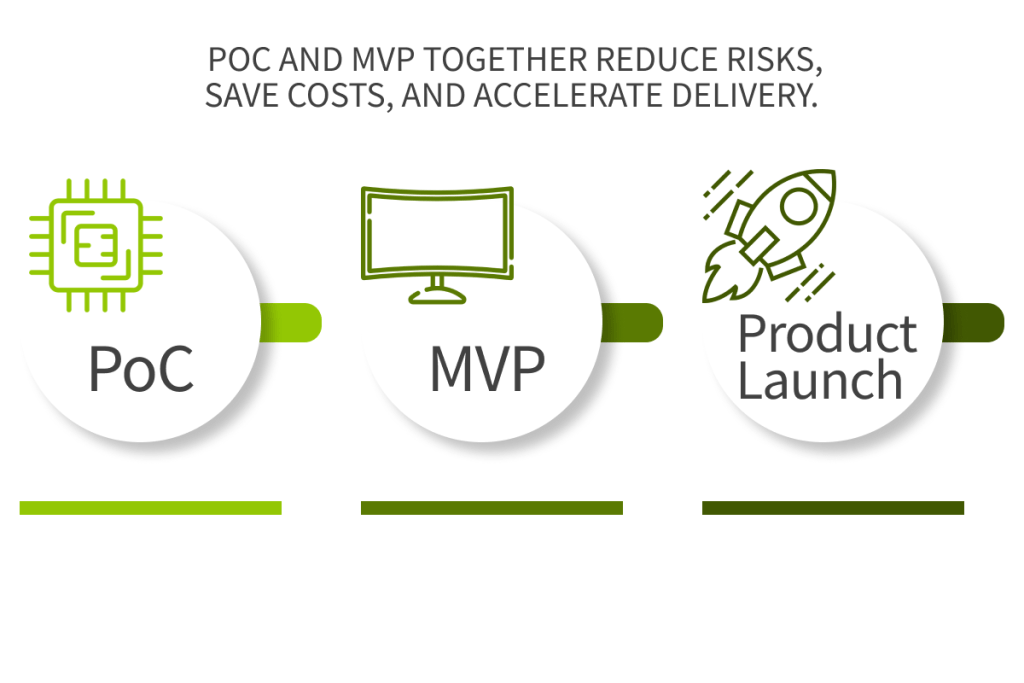
Proof of Concept and Minimum Viable Product are not separate stages but connected parts of an efficient product development process. The PoC verifies that the idea can be built. The MVP proves that it can succeed in the market. Together, they create a cost-efficient and data-driven way to move from hypothesis to measurable business value.
At OneLogicSoft, we help companies validate their ideas before committing to full-scale development. Our approach combines Project Specification, App Development Services, and Quality Assurance in Product Development to ensure every new solution passes both technical and market validation.
We build PoC and MVPs across multiple domains, including Logistics Software Development, Retail Software Development, and Hybrid Apps Development. This approach helps businesses reduce uncertainty, shorten delivery time, and test new functionality safely before scaling.
Our related services include:
• Proof of Concept (PoC) Development – testing your software idea and eliminating implementation risks.
• MVP Development – launching a minimal product version to validate user feedback and market demand.
• Research and Development (R&D) – exploring innovative technologies through structured experimentation.
Whether you need to validate a new logistics platform, design a retail automation tool, or test a cross-platform mobile app, One Logic Soft provides the technical expertise and strategic process to guide your product from concept to launch.
Need help validating your next idea?
Contact OneLogicSoft and let our team guide you from concept to market-ready product.


Have a project in mind?
Let's chat
Your request has been accepted!
In the near future, our manager will contact you.
Have a project to discuss?

Have a partnership in mind?