Fixed Price vs Time and Material for Different Project Risk Levels
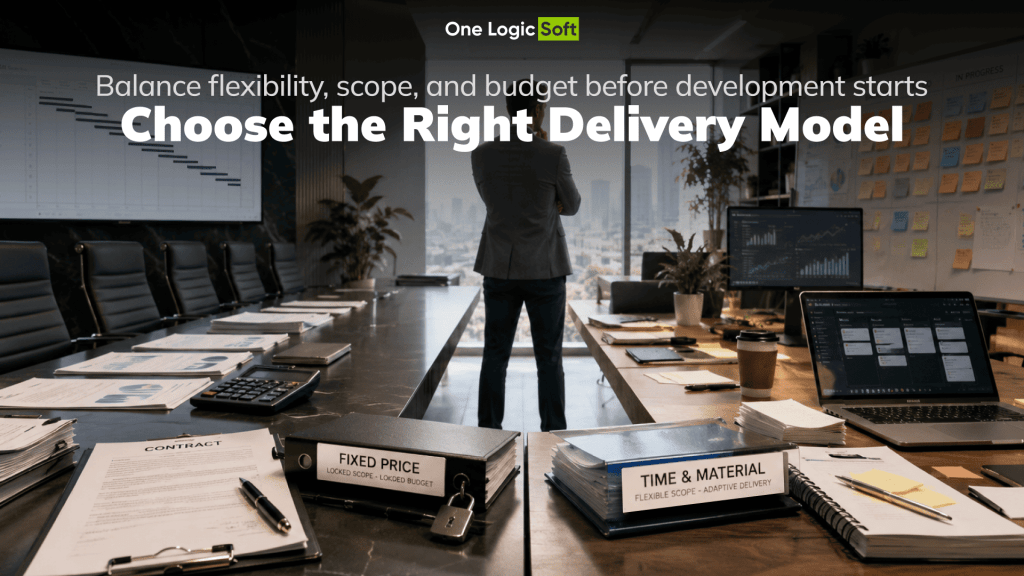
Few decisions affect the outcome of a software project as directly as the contract model. Scope, delivery rhythm, change management, communication patterns, and risk distribution are all shaped before the first line of code is written. The wrong choice between Fixed Price and Time and Material rarely shows up on day one. It shows up around month three, when scope has shifted, change requests are stacking up, and the budget is signaling trouble.
Software is harder to predict than most engagements assume. Research by Bent Flyvbjerg and Alexander Budzier published in Harvard Business Review found that one in six IT projects ends up as what the authors call a “black swan” — projects with average cost overruns of 200% and schedule overruns of nearly 70%. The causes are familiar: optimistic estimates, unstable requirements, weak change control, and a contract model that doesn’t fit the reality of the work.
This article compares Fixed Price and Time and Material as software development pricing models, highlights where each one breaks, and explains how cost control in software projects is preserved regardless of the model you sign.
Why the Pricing Model Decides More Than You Think
A pricing model is not a finance choice. It is a delivery model.
Fixed Price tells the team that scope is the constant and time and money flex around it through a change request flow. Time and Material tells the team that priority is the constant and scope flexes around regular delivery cycles. These two contracts produce different planning routines, different reporting habits, different conversations with stakeholders, and different definitions of “done.”
Most budget problems in custom software start here. Teams pick a model based on what feels safer rather than what fits the maturity of the requirements. A Fixed Price contract built on a half-formed brief looks predictable until the first major change request. A T&M setup without prioritization discipline looks flexible until the burn rate becomes uncomfortable.
Fixed Price: Where It Works and Where It Breaks
Fixed Price means a defined scope, an agreed timeline, and a locked budget. The vendor takes on delivery risk inside the agreed boundaries. The client takes on scoping risk: any change costs extra and may move the deadline.
When Fixed Price Fits
Fixed Price works best when the product can be described in detail before development starts. The strongest fit is short, well-bounded work where the inputs and outputs are clear:
- Marketing websites and landing pages
- Catalog-driven e-commerce builds with a fixed feature set
- Redesigns of existing systems where flows are already known
- Migrations between platforms with documented data and rules
- Fixed feature packages added on top of an active product
- Compliance-driven work where deliverables are dictated by regulation
For projects of this type, the planning effort needed for an accurate estimate is reasonable. The product is close to known, the user flows are stable, and the integrations rarely surprise.
When Fixed Price Quietly Fails
Fixed Price fails when scope is forced into a number that the brief cannot truly support. Three patterns repeat often.
The brief is treated as final too early. If discovery is rushed, the estimate becomes a guess wrapped in a confident document. The first sprint then surfaces what was missing, and the change request engine starts running before the second milestone.
Integrations are scoped from screenshots. Connections to ERP, CRM, POS, payment gateways, warehouse systems, or 1C-style accounting tools regularly behave differently from documentation. Fixed Price assumes those interfaces are stable. Too often they are not.
The product is still searching for shape. Anything close to MVP, R&D, or “we will know more after user feedback” does not match Fixed Price. The contract assumes scope clarity that simply does not exist yet.
The trade-off is structural: Fixed Price buys predictability at the cost of flexibility. The more your project relies on learning, the more you pay for that predictability through change requests and timeline tension.
Time and Material: Where It Works and Where It Breaks
A T&M contract software development setup works on actual hours billed at agreed rates. Scope is shaped continuously through a backlog. Delivery happens in cycles typically weekly or biweekly with regular demos, planning sessions, and reporting.
This model fits products that grow over time. Priorities are expected to shift. Discovery never fully ends. Each release improves the product instead of finishing it.
When Time and Material Fits
T&M is the standard for any roadmap-driven product:
- SaaS and subscription products with continuous releases
- Logistics, retail, and healthcare platforms tied to real operations
- Mobile applications evolving alongside user behavior
- Internal tools where workflows change with the business
- Long-term maintenance and feature development on existing systems
- MVPs that need to adapt as users push back on early hypotheses
Inside an agile delivery model, T&M aligns the contract with how engineering actually works. Teams plan in increments, deliver small pieces, learn from each one, and adjust the next batch. The contract does not fight that rhythm.
When Time and Material Quietly Fails
T&M fails when discipline is missing. The model is flexible by design, which becomes a problem if the client side cannot decide what matters first.
Priorities are unclear. Without a real product owner deciding what enters each sprint, the team works on whatever request came in last. Burn rate climbs, but the product does not move.
Demos and reporting are skipped. T&M only stays transparent when there is a steady cadence: weekly demos, sprint reviews, time tracking visible to the client, and a backlog the client actually opens. Without that, “trust the team” becomes the de facto governance model, and budget surprises follow.
Estimates are treated as decoration. Each sprint should carry rough estimates per task. If estimates are not produced or never compared with actuals, the team loses the early warning signal that something is harder than expected.
The trade-off here is the mirror image of Fixed Price: T&M buys flexibility at the cost of predictability. You only get the value of that flexibility if your team uses it deliberately.
Side-by-Side Comparison
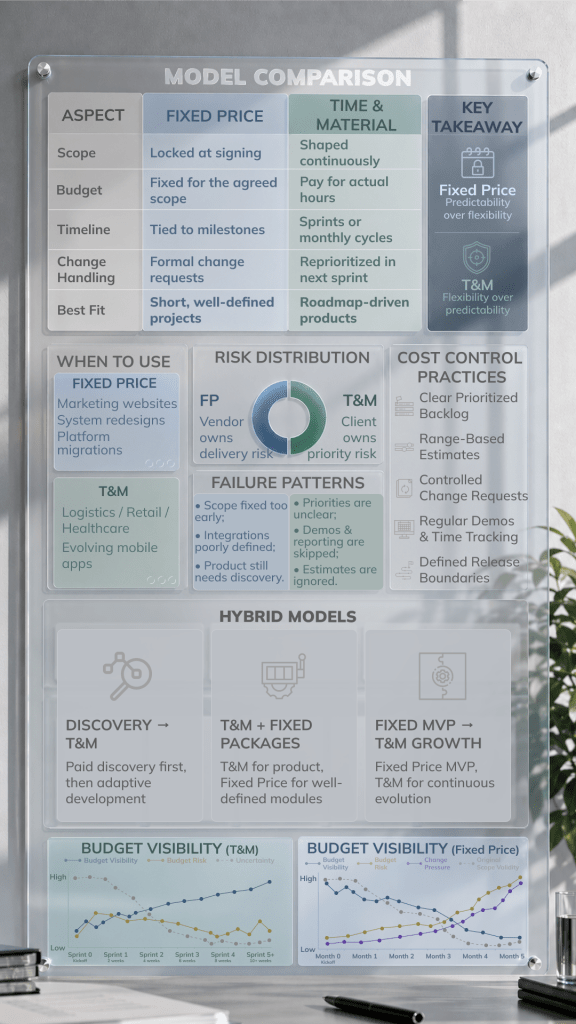
| Aspect | Fixed Price | Time and Material |
| Scope | Locked at signing | Shaped continuously through the backlog |
| Budget | Fixed for the agreed scope | Pay for actual hours at agreed rates |
| Timeline | Tied to milestones | Delivered in sprints or monthly cycles |
| Best fit | Short, well-defined projects | Roadmap-driven products and long-term work |
| Change handling | Formal change requests, billed separately | Reprioritized in the next sprint |
| Discovery requirement | High before signing | Continuous during delivery |
| Risk on vendor side | Delivery and overrun within agreed scope | Mainly velocity and quality |
| Risk on client side | Underspecified scope, change cost | Weak prioritization, burn without progress |
| Reporting style | Milestone acceptance | Sprint demos, time logs, backlog tracking |
| Typical duration | 1–3 months | Ongoing, 3+ months |
| Documentation pressure | Heavy upfront | Built up through delivery |
| Project management overhead on the client side | Lower | Higher |
A practical reading of the table: if the project can be described well enough that an honest team agrees to a Fixed Price without heavy assumptions, Fixed Price is usually fine. If the brief still has open questions, the right answer is either deeper discovery first or a T&M setup from the start.
Hidden Costs Each Model Tends to Hide
Neither model is cheaper by default. The cheaper model is the one that fits the project. When models are misapplied, the cost shows up indirectly.
Fixed Price hidden costs. Heavy estimation and discovery effort gets baked into the price. Conservative buffers protect the vendor and inflate the number. Change requests carry their own coordination overhead that no one bills for. If the original scope was wrong, integration rework, redesign, or partial rebuilds appear later as separate “phase two” engagements.
T&M hidden costs. Unprioritized backlog items still get worked on. Decisions get reopened because no one logged them. Demos turn into status updates instead of working software. Time tracking is only as honest as the team running it. Without strong product ownership on the client side, even a strong vendor will burn hours without moving real metrics.
Most “budget overruns” are these costs catching up after a model mismatch.
Hybrid Models Are Often the Honest Answer
Real projects rarely fit one model end-to-end. The most stable engagements often combine pieces:
- Fixed Price discovery, then T&M build. A short, paid discovery phase produces a real backlog, a working architecture sketch, and a prioritized roadmap. The development phase moves to T&M, where the team can react to what discovery surfaced.
- T&M core development with Fixed Price feature packages. Ongoing development sits in T&M. A specific, well-defined module for example, a payment integration with a fixed third-party API is contracted as Fixed Price.
- Fixed Price MVP with a T&M growth phase. A bounded MVP is delivered for a fixed price. Once the product is live and real usage starts, the team moves to T&M to evolve the product based on feedback.
The deeper view of contract design and engagement structure is covered on the cooperation models, including Dedicated Team, R&D, PoC, and MVP variants.
Cost Control in Software Projects: What Actually Protects the Budget
Cost control in software projects does not come from the contract. It comes from the practices around it. The following habits protect the budget under Fixed Price, T&M, or any hybrid.
A real backlog, not a wishlist. Items are described well enough to be estimated. Acceptance criteria exist. Priorities are explicit. Anything that cannot be explained cannot be safely built.
Estimates as ranges, not single numbers. Senior engineers estimate with confidence intervals. The wider the range, the higher the uncertainty. Wide ranges become discovery tasks, not commitments.
A change request flow that is actually used. Even on T&M. Material scope changes new modules, new integrations, new compliance requirements should be recorded as decisions, not absorbed quietly into the next sprint.
Demos every one to two weeks. Working software is the most reliable progress report. Slide decks are not.
Visible time tracking and burndown. The client can see effort by task. Spikes are explained. Trends are discussed before they become surprises.
A decision log. Architecture choices, scope decisions, and priority shifts are written down with reasons. This is the cheapest way to prevent re-litigated decisions.
Defined release boundaries. Each release has a clear scope, a clear date window, and a clear acceptance gate. Without this, “almost done” becomes the default status forever.
These practices are the same ones we apply on long-running engagements documented across our case studies — order management for 3PL operators, multi-store Shopify Plus rollouts, healthcare booking platforms, and AR/VR product experience apps. Different industries, the same delivery discipline behind the contract.
A Short Decision Framework
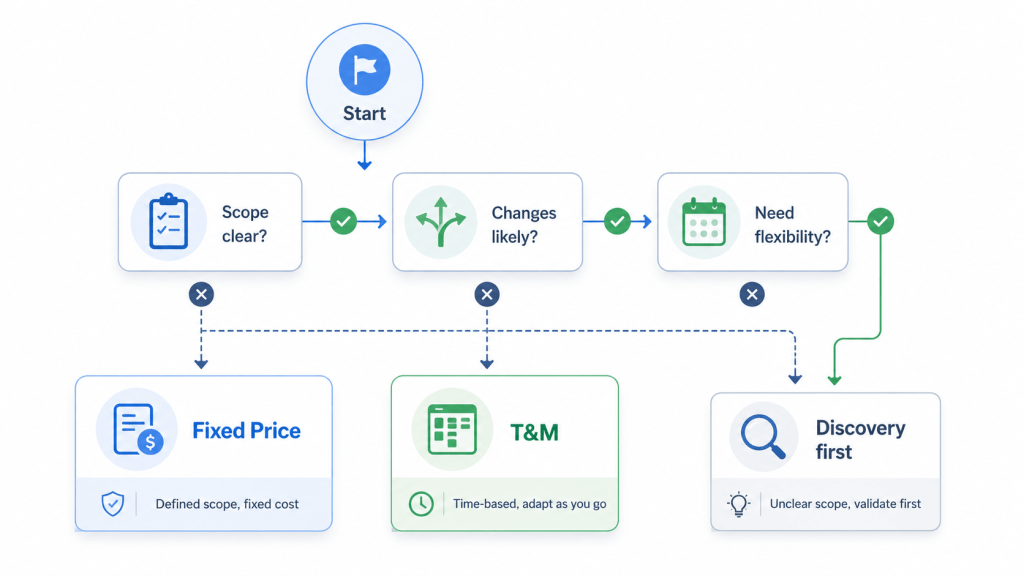
Before signing, answer five questions honestly. The answers point to the right model more reliably than a sales conversation does.
- How clear is the scope? If you can describe every screen, flow, integration, and edge case, Fixed Price is on the table. If half of that is still “we will figure it out,” Fixed Price will hurt.
- How likely are priorities to shift? Stable priorities favor Fixed Price. Evolving priorities favor T&M.
- How long is the project? Anything beyond three months tends to drift; T&M handles drift more honestly.
- How mature is your product ownership? T&M needs an empowered owner on the client side. Without one, Fixed Price imposes useful structure.
- What kind of unknowns dominate? Unknown integrations, unknown user behavior, and unknown compliance requirements all argue for discovery first, then T&M.
If two or more answers point to instability, plan a discovery phase before locking any contract even a short one. Cheaper questions answered now save expensive change requests later.
How One Logic Soft Approaches Engagement Models
Our approach to custom software development starts with matching the engagement model to the actual maturity of the requirements, not to the preference written into the brief. For short, well-defined work, Fixed Price is genuinely the simpler choice. For products tied to live business operations logistics, retail, healthcare, e-commerce T&M and Dedicated Team setups consistently produce better outcomes because they keep the contract aligned with how the product needs to evolve.
In practice, that often looks like a paid discovery phase, an honest range-based estimate, a backlog that can be reviewed before signing, a defined cadence of demos, and clear ownership on both sides. The model is chosen to support that work, not the other way around.
FAQ
What is the main difference between Fixed Price and Time and Material?
Fixed Price locks scope, timeline, and budget upfront, with changes handled through a formal change request flow. Time and Material bills actual hours at agreed rates and shapes scope through a continuously prioritized backlog. Fixed Price favors predictability; T&M favors flexibility.
Which pricing model is cheaper?
Neither model is cheaper by default. The cheaper model is the one that matches the project. Fixed Price tends to be cheaper when scope is genuinely stable. T&M tends to be cheaper when scope evolves, because Fixed Price change requests carry overhead and conservative buffers.
Is Time and Material the same as Agile?
No. T&M is a contract model; Agile is a delivery approach. They pair well because both assume scope evolves through cycles, but you can run Agile inside Fixed Price for a bounded scope, and you can run T&M poorly without any Agile discipline.
Can we start with Fixed Price and switch to Time and Material later?
Yes, and this is one of the most common patterns. A bounded first release discovery, MVP, or a defined feature package is delivered as Fixed Price. Ongoing development moves to T&M once the product is live and real learning begins.
How do I keep a T&M contract under control?
Three practices do most of the work: a real backlog with acceptance criteria, regular demos with visible time tracking, and clear product ownership on the client side. Without those, T&M flexibility turns into uncontrolled spend.
When does Fixed Price become risky?
Fixed Price becomes risky when the brief still has open questions, when integrations are scoped from screenshots rather than tested interfaces, or when the project is closer to discovery than delivery. In those cases, the price is built on assumptions that the first sprint will start to break.
What does a healthy estimate look like?
A healthy estimate is a range with explicit assumptions, a list of risks, dependencies on third parties, and a description of what is included and what is not. A single confident number from a vague brief usually signals weak estimation, not a strong vendor.
How does cost control work without a fixed budget?
Cost control under T&M relies on visible burn rate, a prioritized backlog, regular demos, and a decision log. The budget is protected sprint by sprint instead of milestone by milestone, but the controls are equivalent in strength when applied consistently.


Have a project in mind?
Let's chat
Your request has been accepted!
In the near future, our manager will contact you.
Have a project to discuss?

Have a partnership in mind?