How to Validate AI Use Cases Before Building Anything
Why validation is where AI projects succeed or fail
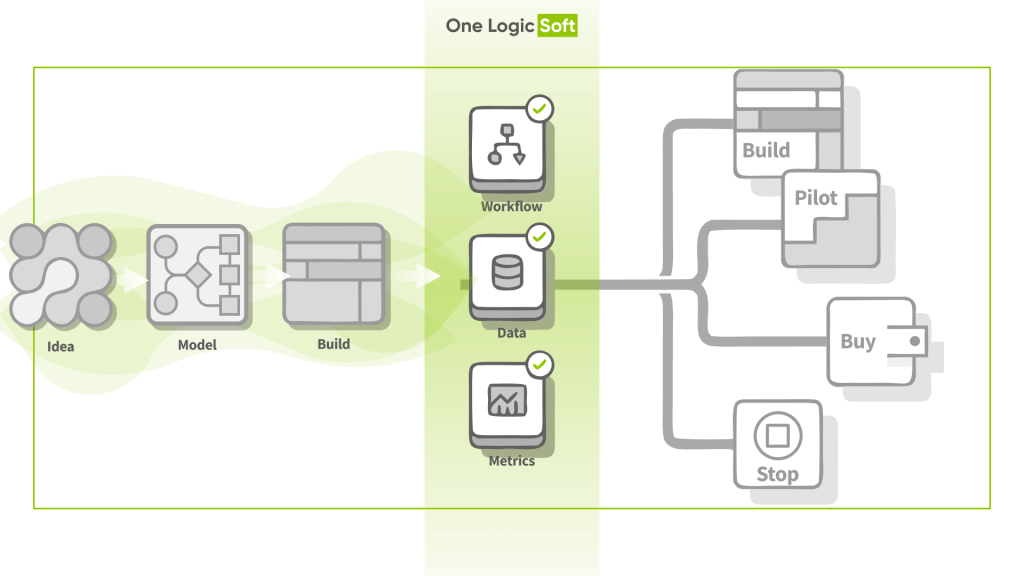
Most AI initiatives fail before model choice becomes relevant. The break happens earlier: teams move into implementation without proving three fundamentals – a real workflow need, usable data, and measurable value.
Validation is a short, structured phase that ends with a decision you can defend: build, pilot, buy, integrate, or stop. It protects engineering time by forcing scope discipline and by making stakeholders agree on what success means in numbers.
This mindset is closely connected to QA in Product Development. You define acceptance criteria, test conditions, and failure modes before code exists, then you measure outcomes against those definitions.
What a validated AI use case looks like
A use case is validated when you can answer these questions with evidence:
- Who uses it, and exactly where it fits in the workflow
- What changes after the output appears (decision made, task routed, record updated)
- What baseline exists today (time, cost, error rate, conversion, risk)
- What data powers it, and what constraints apply (privacy, compliance, access)
- How success will be measured during a pilot, with numeric thresholds
- Who owns the process after launch (operations, feedback loop, accountability)
If one of these is missing, the initiative is still a concept.
The validation process
Step 1: Write a one-page use case brief
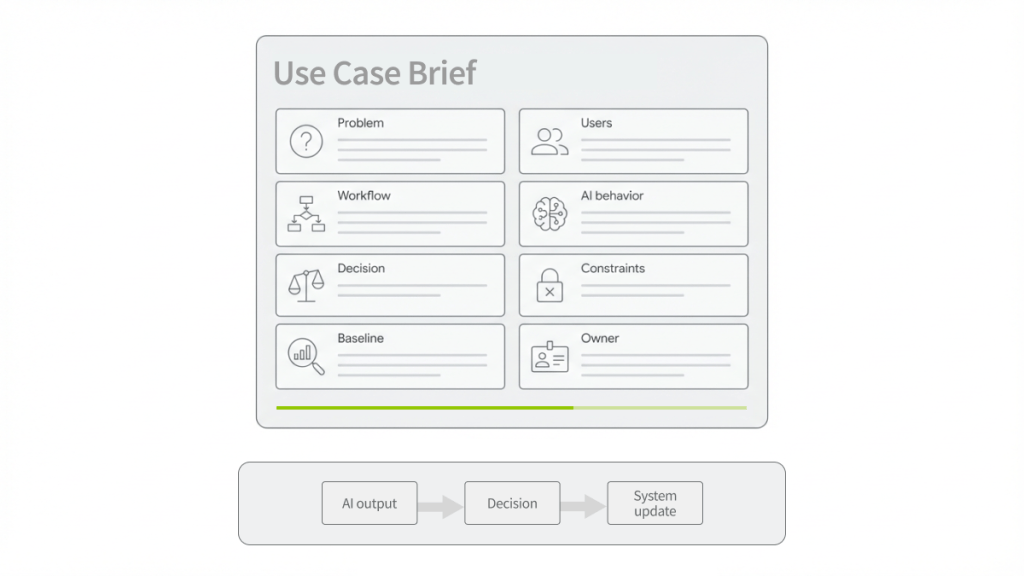
If the use case cannot fit in one page, it is still brainstorming. The brief forces clarity and removes vague goals like “improve productivity”.
Include:
- Problem statement: one sentence in operational terms
- Primary users: roles, volume, frequency
- Current workflow: 5-10 steps, tools used, points of delay or rework
- Proposed AI behavior: inputs, output format, when the output appears
- Decision or action: what the user does next, what system is updated
- Constraints: security, privacy, latency, regulatory, explainability needs
- Baseline: current numbers you can measure today
- Owner: one accountable business owner
Deliverable: Use Case Brief (1 page) with ownership and a measurable baseline.
Step 2: Rank candidates with a scorecard
Teams often pick ideas based on novelty or executive preference. A scorecard forces a decision based on feasibility and value.
Run scoring with at least two stakeholders present (business owner plus tech lead). Require evidence for high scores. Pick one primary candidate and one backup, then freeze the rest until the pilot produces results.
AI use case validation scorecard
| Dimension | What you are checking | Evidence you need | Score (1-5) |
| Business impact | savings, revenue lift, risk reduction | baseline metric + rough estimate model | |
| Workflow fit | daily usefulness, low friction | user interviews + workflow map | |
| Data readiness | availability, quality, permissions | sample data + quick profiling | |
| Time to pilot | how fast you can test | integration notes + scope limit | |
| Risk and compliance | privacy, security, policy risk | data classification + review notes | |
| Operability | ownership, monitoring, feedback loop | RACI + operational outline |
Outcome: a ranked shortlist that is defensible to engineering, product, and leadership.
Step 3: Validate the workflow before you validate the model
A model can be accurate and still fail if the output does not land inside a real decision point.
Confirm with real users:
- The exact moment the decision is made today
- The inputs they trust today, and why
- The mistakes that cause real damage (rework, refunds, churn, policy risk)
- The minimum useful output that still changes behavior
Deliverable: Workflow map plus a failure modes list (what can go wrong and what happens next).
Step 4: Run a fast data feasibility check
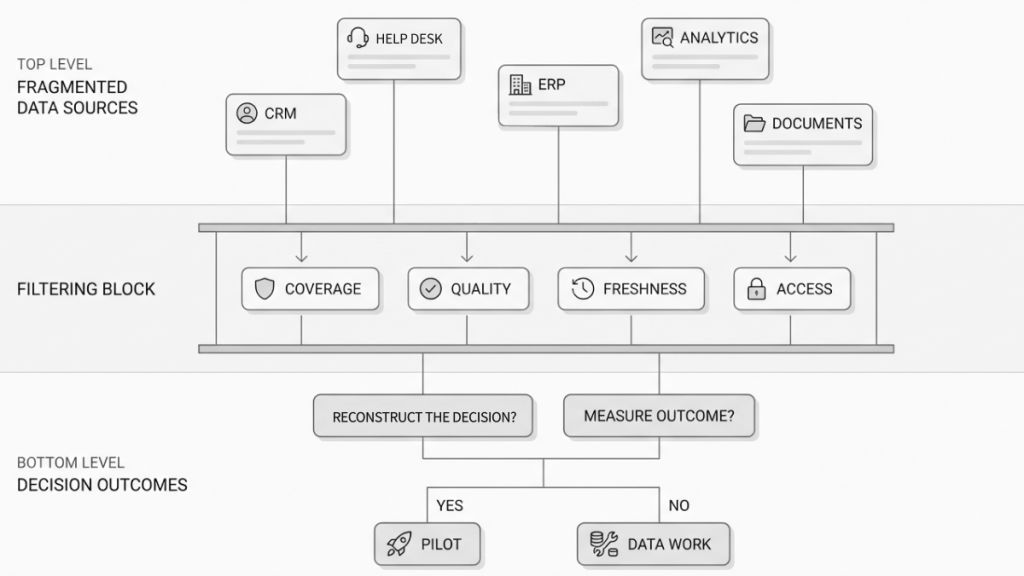
You do not need perfect pipelines for validation. You need proof that the data exists, is accessible, and supports the decision you want to improve.
Check:
- Sources: CRM, ticketing system, analytics, ERP, documents, call transcripts
- Coverage: enough examples across normal and edge cases
- Quality: missing fields, duplicates, inconsistent naming, outdated labels
- Freshness: how often it updates, what breaks if it is stale
- Access rules: permissions, audits, retention rules
- Sensitive data: PII, finance, health, contracts, internal secrets
A simple test with a small sample:
- Can we reconstruct the current decision from data?
- Can we measure the current outcome reliably?
If either answer is “no”, the value may still be real, but the first milestone becomes data work.
Deliverable: Data Readiness Note with blockers, fixes, and a realistic pilot scope.
Step 5: Define success metrics and acceptance criteria
Avoid “accuracy” as the headline KPI. Tie metrics to operational outcomes, and set thresholds before the pilot begins.
Metrics that usually work better:
- Time saved per case (minutes per task)
- Reduction in rework (reopens, edits required, manual fixes)
- Handling time reduction (support and operations)
- Deflection rate with verified outcomes (tickets truly avoided)
- Conversion lift (when output influences a buying step)
- Compliance outcomes (fewer risky outputs, better traceability)
Acceptance criteria examples:
- 20% reduction in handling time for a defined workflow
- 15% reduction in rework rate over two weeks
- 90% user acceptance for suggestions in a controlled flow
- Zero policy violations in defined sensitive categories
Deliverable: Pilot success criteria with numeric thresholds.
Step 6: Design a pilot that proves value with minimal build
A pilot is a controlled experiment that answers one question: does this use case create measurable value in a real workflow?
Rules:
- Scope to one workflow and one user group
- Constrain output to one primary action
- Keep human review for high-risk decisions
- Log inputs, outputs, edits, actions, outcomes
- Time-box the pilot and define stop conditions
Pilot formats that work:
- Internal tool panel that suggests actions and logs edits
- Assisted triage in a ticketing system
- Document extraction into structured fields, with reviewer approval
- Sales call summaries with action items, confirmed by the rep
Deliverable: Pilot plan with scope, instrumentation, and evaluation.
Step 7: Decide: build, buy, or integrate
Validation should end with a rational path forward.
- Buy when the workflow is common and vendor maturity is high
- Integrate when your stack is strong and you need AI in-context
- Build when the workflow is unique, data is proprietary, and differentiation matters
The decision is about speed, risk, and long-term operating cost.
Deliverable: Decision memo tied to evidence, not preference.
From pilot to production
A pilot proves value. Production requires reliability, monitoring, and a stable operating model. This is where Support and Maintenance becomes part of the plan.
Production readiness checklist:
- Clear ownership for ongoing quality and cost
- Monitoring for drift and degradation
- Audit logs and traceability for regulated workflows
- Feedback loop for corrections and retraining signals
- Safety rules and escalation paths, with fallback behavior
- Release process for prompt, policy, and model updates
Red flags that mean “stop or re-scope”
- No baseline metrics, so value cannot be proven
- No workflow owner who can drive adoption
- Output is “insights” with no defined action
- Data exists but cannot legally be used as planned
- The real issue is a broken process, and AI is being used as a shortcut
Use cases that validate well
Operations and support
- Ticket classification and routing
- Draft responses grounded in internal references
- Knowledge base gap detection and article drafting
- Call summaries with action items and CRM updates
Sales and marketing ops
- Lead enrichment and qualification suggestions
- Proposal drafting from structured requirements
- Content compliance checks and brand consistency enforcement
Finance and back office
- Invoice and contract field extraction
- Exception detection with review queues
- Policy checks for approvals
Strong early candidates share three traits: repetitive workflow, measurable baseline, and low-friction adoption.
Reusable validation gate
Use this as a quick check before engineering starts:
- Use Case Brief fits in one page
- Workflow map includes a clear decision point
- Baseline metrics exist and can be measured now
- Data readiness confirmed with a sample review
- Pilot success criteria defined with numeric thresholds
- Business owner assigned for adoption and ongoing operation
If one item is missing, the next step is still validation work.
Next step
If you share 3-5 candidate use cases and the systems involved (CRM, helpdesk, ERP, e-commerce, internal portal), we can turn them into a ranked shortlist and a single pilot plan with clear metrics and acceptance criteria.
FAQs
What is the difference between validation and a pilot?
Validation confirms the use case is worth testing and testable with available workflow and data. A pilot is the controlled test that produces measurable results in a real workflow.
How long should validation take?
For most business workflows, validation is effective when it stays short and disciplined, commonly from a few days up to a few weeks, depending on data access and stakeholder availability.
Do we need perfect data to validate a use case?
No. You need enough data to prove feasibility and define realistic pilot scope. Data cleanup can become a pilot milestone if the value case is strong.
Should we start with automation or AI?
Start with the simplest approach that changes outcomes. If a rule-based automation solves the problem, that is often the right first move.
How do we avoid a demo that never gets adopted?
Tie the output to a real decision point, measure adoption, and assign a business owner for the workflow after launch.
What makes an AI use case high risk?
High risk comes from sensitive data, regulated outputs, irreversible decisions, and unclear accountability. Keep human review in the loop during early phases.
What should we log during a pilot?
Inputs, outputs, user edits, final actions taken, timestamps, and outcome signals. Without logs, you cannot measure improvement or diagnose failures.


Have a project in mind?
Let's chat
Your request has been accepted!
In the near future, our manager will contact you.
Have a project to discuss?

Have a partnership in mind?