Software Requirements Specification Guide 2026
By the time the first sprint starts, the most expensive bugs are already in the project. They are not in the code. They sit in requirements no one wrote down, roles no one mapped, integrations no one tested, and acceptance criteria no one approved.
Here is the pattern. A client asks for “a customer portal with order tracking.” The first brief fits one slide: login, order list, order details, status updates, admin panel. Two weeks of discovery later, the picture changes. Different client groups need different visibility. Operations wants internal notes the customer never sees. Finance wants exports. Managers want manual correction of bad ERP statuses. The ERP itself stores statuses in three inconsistent formats. The portal still looks simple from the outside, but the work behind it is no longer a five-line feature list. It is a software requirements specification that has to define permissions, data flow, fallback logic, QA scenarios, and sign-off rules.
This is exactly where projects break. PMI’s 2014 Pulse of the Profession research on requirements management found that inaccurate requirements management drives 47% of failed projects and burns $51 million for every $1 billion spent on programs. A commonly cited summary of Standish Group’s CHAOS 2020 report puts the broader number even higher: roughly two-thirds of technology projects end in partial or total failure. The original CHAOS research also listed a clear statement of requirements among the top three project success factors.
A useful SRS has to do three things: clarify scope, make requirements testable, and give the team a shared basis for estimation, development, QA, and release planning.
The Three Gaps That Quietly Eat the Budget
Most teams know an SRS needs goals, features, and technical notes. The expensive mistakes come from three areas that feel secondary during kickoff calls and turn into change requests during sprint three.
Admin logic is the first gap. Customer-facing screens get attention. Internal tools stay vague. Yet the admin side runs the real product after launch: manual correction, audit history, bulk actions, exports, user management, status overrides, approval flows, error logs, support workflows. Strip these out of the specification and the estimate misses a third of the system.
Edge cases are the second gap. A payment fails after the order is already created. A shipment status changes after the document was generated. A clinic cancels after the patient got the reminder. The API returns half the expected fields. A duplicate customer record sneaks in through two channels. A mobile user loses connection halfway through checkout. None of these cases need dramatic language. They need rules, written before development, not discovered during QA.
Non-functional requirements are the third gap. Performance, security, scalability, browser coverage, device support, data retention, backups, audit logs, availability, localization – these shape the real delivery effort. Calling them “non-functional” makes them sound optional. They are not. A booking platform that crawls under clinic load is not ready. A retail app that crashes on a three-year-old Android is not ready. A logistics system without reliable status tracking is not ready.
A specification that actually protects the project pins down five things before anyone writes code:
- Roles: who can view, edit, approve, export, assign, cancel, delete, and restore each data type
- States: what happens before, during, and after every key business action
- Admin actions: what internal teams need to control after launch
- Failure behavior: how the system handles errors, failed payments, broken sync, duplicates, and missing data
- Acceptance criteria: how the team proves a requirement is done
At that point the document stops being a feature list. It becomes a delivery agreement.
What an SRS Actually Contains
Business Goal, Scope, and Release Logic
An SRS opens with the business reason for the product, not with a feature inventory. One paragraph answers four questions: which process needs to change, who is affected, what the first release has to prove, and how stakeholders will measure success.
For a retail app, success is shorter checkout queues and cleaner loyalty usage. For a logistics platform, fewer manual order updates and tighter delivery visibility. For a healthcare booking product, less coordination work between patients, doctors, and clinic staff.
The scope section then draws a hard line between release one and the roadmap. This is where most projects lose discipline. Every idea drifts into the first build. Strong scope writing marks what is confirmed, what needs validation, what belongs to later releases, and which assumptions still carry risk.
Prioritization belongs here, and the method matters less than the decision discipline. MoSCoW separates must-have, should-have, could-have, and won’t-have. RICE ranks reach, impact, confidence, and effort. WSJF weighs delay cost against delivery effort. Whichever framework the team picks, the SRS has to show why release-one scope is release-one scope, not just what it is.
This is where project specification work pays back. Turning rough product intent into estimable scope, milestones, and risks is a planning job, not a coding job.
Users, Permissions, and Workflow Rules
Roles drive architecture more than early briefs admit. “Admin,” “manager,” and “customer” are placeholders, not roles. Each one changes screens, backend rules, notifications, audit logs, security boundaries, and test scenarios.
Concrete examples make the point. A manager approves requests but cannot delete records. A support agent reads customer history but never sees payment data. A dispatcher updates shipment statuses but cannot touch billing fields. A clinic admin manages doctors and schedules but stays out of financial records.
A role-permission matrix makes this visible before anyone writes a single API endpoint.
| Action | Admin | Manager | Support Agent | Customer |
| View customer profile | Yes | Yes | Yes | Own profile only |
| Edit order status | Yes | Yes | No | No |
| Export reports | Yes | Yes | No | No |
| View payment data | Yes | Limited | No | Own payments only |
| Delete records | Yes | No | No | No |
| Add internal notes | Yes | Yes | Yes | No |
This table is not a UI detail. It defines backend logic, database permissions, admin screens, QA cases, and release checks.
Functional Requirements, User Stories, and Use Cases
Teams mix these three up constantly. They are related, but they do different jobs and answer different questions.
A user story captures the need from the user’s perspective: “As a dispatcher, I want to assign a driver to an order so the shipment can move into delivery.” It gives context. It does not define rules.
A functional requirement defines system behavior: “The dispatcher assigns one available driver to an order with Confirmed status. The system records assignment time, dispatcher ID, driver ID, and previous order status.” This is what gets built and tested.
A use case describes the larger interaction: actor, trigger, preconditions, main flow, alternate flows, exceptions, result. Use it when the workflow runs across several steps and several failure paths.
A strong SRS uses all three. Stories explain why the feature exists. Functional requirements define what the system does. Use cases describe how the workflow runs from trigger to outcome.
Non-Functional Requirements and Constraints
This section names the quality bar: performance targets, device coverage, browser support, security rules, audit requirements, backup policies, availability SLOs, compliance constraints, localization rules.
Constraints belong here too. A system might have to work with a legacy ERP, a specific payment provider, a fixed hosting environment, a regulatory boundary, or an internal approval process. Discovering any of these after the architecture is drawn means rework, not iteration.
Assumptions sit alongside constraints. Write them down. “API documentation will be available before sprint planning. Payment sandbox access will be provided by week two. Sample data reflects real production records.” Assumptions are not filler. They protect the estimate from false certainty.
Data Flow, Integrations, and External Interfaces
“Connect the CRM” is not a requirement. It is the start of a conversation.
Real integration requirements name the connected systems, data ownership, sync direction, required fields, API access, error handling, retry logic, fallback behavior, and test environments. Skip any of those and integration risk moves straight into the sprint backlog, usually around the time it is most expensive to fix.
Logistics products surface this problem fast. In the UVK order management system, One Logic Soft worked through 1C integration, Google Maps API, document generation, QR codes, mobile notifications, and long-term support. The published case reports 98% on-schedule delivery in top cities and delivery planning compressed to under 40 minutes. None of that survives a vague integration brief.
Glossary, Sign-Off, and Change Control
A glossary prevents arguments dressed up as bugs. “Order,” “shipment,” “booking,” “client,” “account,” “status,” “completed,” “canceled” – each one means something different to sales, operations, finance, support, and engineering. Define them once.
Sign-off rules name who approves the requirements, who requests changes, who accepts final scope, and how the team handles new ideas after development starts. Without sign-off, every Friday stand-up reopens scope.
An SRS does not freeze the product forever. In Agile delivery it works as a living document. Requirements evolve, but every change carries an owner, a reason, an impact note, and a clear path into the backlog. The document lives where the team already works: Confluence, Notion, Jira, Linear, Google Docs, with version history turned on.
Mini-Case: How an SRS Reshapes a “Simple Portal”
A B2B company asks for a client portal with order tracking. The brief fits one slide.
Before discovery:
- Login
- Order list
- Order details
- Status updates
- Admin panel
The estimate looks tight. Six weeks, one designer, two developers, one QA engineer.
Then discovery happens. Different client groups need different visibility: distributors see one set of fields, end-customers another. Managers need manual status correction because the legacy ERP stores statuses in three inconsistent formats. Operations needs internal notes hidden from clients. Finance needs exports filtered by region. The ERP has no documented API and no stable test environment.
After discovery:
| Workstream | Scope |
| Release 1, 8-10 weeks | Role-based login, order visibility per client type, status display with normalization layer, manual admin correction, CSV exports filtered by client and region |
| Validation track, parallel, 2 weeks | ERP field mapping, sync behavior under load, failure handling, test environment setup |
| Roadmap, post-launch | Advanced reporting, finance automation, role-specific dashboards, full status history with audit log |
The new estimate is bigger. The new estimate is also real. The first version protected nothing. It priced the slide, not the system. The second version prices the work and shows where the risk sits.
This is what an SRS buys: a budget that survives contact with reality.
Weak vs Strong Requirements
The single biggest test of an SRS is whether QA can act on it without asking follow-up questions. Most weak requirements fail that test. Most strong ones pass it because they replace adjectives with conditions.
| Weak | Strong |
| The user can manage orders. | The dispatcher creates, edits, assigns, cancels, filters, and exports orders by status, client, delivery date, assigned driver, and warehouse location. |
| The system sends notifications. | The system sends email and in-app notifications when an order status changes from Confirmed to Assigned, Delayed, Delivered, or Canceled. |
| Admin can see reports. | Admin views daily, weekly, and monthly order reports with filters by client, region, status, and assigned manager. Reports export as CSV. |
| The app should be fast. | The order list loads in under 2 seconds for up to 10,000 records when filtered by status and delivery date, under normal server load. |
| Users can reset passwords. | Users request a password reset link by email. The link expires after 30 minutes and becomes invalid after one successful reset. |
Strong requirements strip out guesswork. A developer sees what to build. A tester sees what to verify. A product owner sees what to accept.
Traceability: Connecting Goals to Tests
Once requirements get specific, the next risk is drift: building the right feature for the wrong reason. A requirements traceability matrix prevents that by linking every requirement back to the business goal it serves and forward to the test that proves it works.
Picking up the portal mini-case from above:
| Business Goal | Requirement | Acceptance Criteria | Test Case |
| Reduce manual order updates | Dispatcher assigns drivers to Confirmed orders | Assignment logs dispatcher ID, driver ID, time, and previous status | Verify with valid driver, unavailable driver, and canceled order |
| Improve customer visibility | Customer views own order status history | History shows time, status, actor, and note when present | Verify customer sees own orders only, not others’ |
| Cut finance export work | Admin exports monthly order report | CSV includes client, order ID, status, delivery date, amount | Verify export filters and file format under load |
Traceability also helps when comparing vendors. If a proposal lists features but cannot link them back to acceptance criteria and QA coverage, the estimate still carries hidden risk, no matter how confident the number looks.
Practical SRS Structure: A Summary View
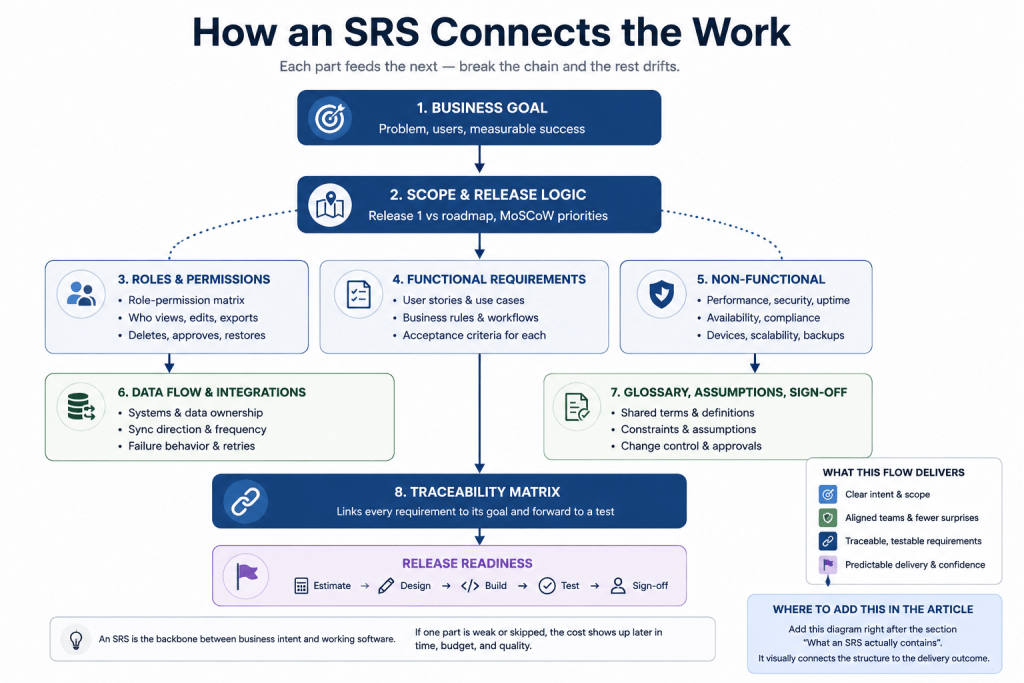
A useful SRS is judged by whether the team can estimate, design, build, test, and release with fewer assumptions. Not by length. Here is the structure that consistently survives contact with delivery:
| SRS Part | What It Clarifies | Common Mistake | Practical Output |
| Business goal | Business problem, users, expected result | Listing features with no measurable outcome | Product purpose statement |
| Scope boundaries | First release, roadmap, open questions | Treating every idea as release one | Scope map and priority list |
| Roles and permissions | Access rights, actions, responsibility | Using vague labels like “admin” | Role-permission matrix |
| Functional logic | System actions, states, admin tools | Writing requirements QA cannot test | Requirements with acceptance criteria |
| Data and integrations | Systems, ownership, sync, errors | Naming the system without data rules | Integration notes and field mapping |
| Non-functional requirements | Performance, security, devices, availability | Adding quality expectations too late | Quality and release criteria |
| Glossary and assumptions | Terms, constraints, dependencies | Letting teams define words differently | Shared terms and assumption log |
| Sign-off and change control | Approval, scope changes, decision rights | Letting scope reopen every sprint | Approval flow and change process |
These parts connect. Business goal drives scope. Scope drives requirements. Requirements drive test cases. Test cases drive release readiness. Break the chain at any link and the rest starts to drift.
How an SRS Sharpens the Estimate
A software estimate is only as strong as the assumptions behind it. Vague requirements force the vendor to estimate an interpretation. Structured requirements force them to estimate the work.
A real specification clarifies feature size, workflow depth, backend logic, integration scope, data migration, QA effort, release preparation, team composition, support expectations, and client-side dependencies. It also makes exclusions visible, which matters more than most clients realize when comparing proposals.
One proposal includes business analysis, architecture, QA, DevOps, documentation, and launch support. Another prices mostly development hours. The total at the bottom of each document does not tell that story. The requirements, assumptions, and exclusions do.
When picking a software development company, pay attention to the questions the vendor asks before sending a number. A mature team asks about workflows, roles, integrations, data, risks, QA, ownership, and release conditions. A junior team asks for the deadline.
Pre-Development Checklist
Run through this list before asking for a final estimate or approving the first sprint:
- Business result the product needs to create, defined and measurable
- User groups and permission levels, listed
- Current workflow including manual steps, mapped
- Future workflow after launch, mapped
- Must-have release scope separated from roadmap, confirmed
- Three to five sample requirements written with acceptance criteria
- Connected systems, APIs, files, spreadsheets, and data sources, listed
- Integration access details and vendor limits, gathered
- Performance, security, device, browser, and availability expectations, set
- Sign-off owner and change approval process, named
The checklist does not replace discovery. It makes the first estimation conversation sharper and protects everyone from estimating a product that does not exist yet.
How One Logic Soft Uses Specification
One Logic Soft treats specification as part of project control, not paperwork before the real work starts. The goal is to move from rough product intent to a delivery base that supports estimation, design, development, QA, release planning, and long-term support.
This approach fits products where software carries operational weight: logistics platforms, retail apps, booking systems, B2B portals, internal tools, reporting systems, CRM-connected workflows. If your team has a product idea, unfinished scope, vendor transition, unclear integration plan, or an internal process that needs software backing it, structured specification gives the project a clearer estimate and a safer roadmap.
Talk to us about your specification.
FAQ
What is a software requirements specification?
A structured document that defines what the software does, who uses it, how workflows behave, which systems connect, what constraints apply, and how the team verifies completion. It is the bridge between business intent and delivery.
What is the difference between SRS, BRD, and FRS?
A BRD answers why. An FRS answers what the system does. An SRS combines both, plus non-functional requirements, constraints, interfaces, and acceptance criteria, making it the most complete of the three.
What is the IEEE 830 format for SRS?
IEEE 830-1998 was the long-standing recommended practice for writing SRS documents. It was officially superseded by ISO/IEC/IEEE 29148, which covers requirements engineering across systems and software lifecycles. Most modern teams pull structure from 29148 rather than 830.
How long should an SRS document be?
Long enough to make the estimate, design, and QA work without follow-up questions. A focused MVP needs a tight document covering scope, roles, workflows, integrations, and acceptance criteria. A logistics platform or B2B portal needs deeper coverage of permissions, data, and edge cases.
Who signs off on an SRS document?
Usually the product owner, technical lead, project manager, and a business stakeholder, sometimes QA and operations. The SRS itself should name the sign-off owner and define how changes get approved later.
Is an SRS useful in Agile development?
Yes, as a living document. It gives the team shared direction at the start, then evolves through controlled updates, backlog refinement, and version history. The mistake is treating it as either a one-time waterfall artifact or a document you skip because “we’re Agile.”
Can development start without a full SRS?
It can. The risk grows fast when roles, workflows, integrations, and acceptance criteria are unclear. A short specification phase almost always costs less than fixing misunderstood requirements during sprint four.
Can One Logic Soft prepare an SRS for an existing product?
Yes. Specification work supports new products, unfinished systems, vendor transitions, modernization projects, and working products that lack clear documentation.


Have a project in mind?
Let's chat
Your request has been accepted!
In the near future, our manager will contact you.
Have a project to discuss?

Have a partnership in mind?