What Teams Need for a Project Estimate Before Development Starts
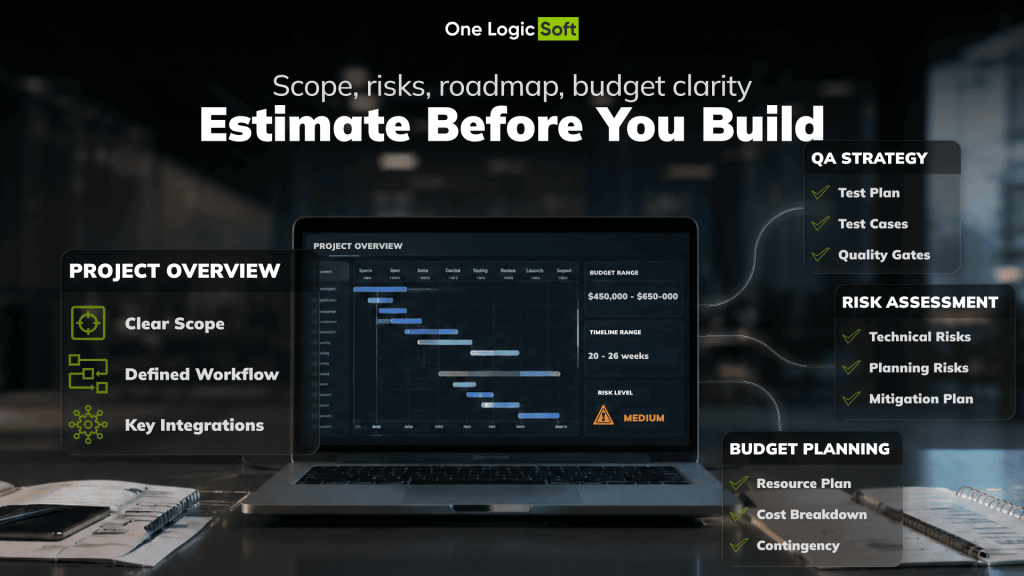
Software project estimation is not a price tag attached to a feature list. A useful estimate shows how the product will work, what needs to be built first, where the risks are, and which decisions can change the budget after development starts.
This matters because weak requirements do not stay harmless. PMI research on requirements management reports that nearly half of unsuccessful projects fail to meet goals due to poor requirements management, and 5.1% of project spending can be wasted for the same reason. Separate McKinsey and Oxford research on large-scale IT projects found that large IT projects run 45% over budget on average and deliver 56% less value than predicted.
For founders, CTOs, product owners, and operations teams, the lesson is clear: a software estimate becomes reliable when assumptions are converted into discovery notes, specification logic, release priorities, risks, milestones, and acceptance criteria.
Why Early Software Estimates Often Break
Many early estimates fail because the request describes the visible part of the product, while the budget depends on the operating logic behind it.
A client may ask for a booking platform, logistics dashboard, retail app, internal portal, or B2B commerce system. On the surface, the request may look like a set of screens. During discovery, the team often finds role-based permissions, payment rules, customer notifications, data migration, API limits, reporting needs, and edge cases that were not part of the first brief.
This is why a low early number can be dangerous. It may compare well in a vendor table, yet it does not protect the client from rework, scope changes, missed integrations, and weak QA coverage.
At One Logic Soft, we usually see the estimate become more useful after the first operational questions are answered: who uses the system, which workflow creates business value, which systems exchange data, and what has to work on launch day.
A stronger estimate does not pretend that every detail is known from the first call. It separates confirmed scope from assumptions, exclusions, open questions, and validation tasks.
Inputs That Shape a Reliable Software Estimate
This part is about inputs. Before a team estimates effort, it needs to know what kind of product is being estimated and what business reality sits behind it.
Business Goal and Release Logic
The first useful question is not “How many features are there?” It is “What business result should the first release create?”
For a retail product, the goal might be shorter checkout queues and cleaner loyalty usage. For a logistics platform, it might be fewer manual order updates and better shipment visibility. For a healthcare platform, it might be smoother appointment booking for patients and less manual coordination for clinic staff.
Once the business goal is clear, the team can separate release-one scope from future roadmap ideas. This protects the budget from trying to include the full product vision in the first build. It gives stakeholders a cleaner way to discuss trade-offs: what needs to launch, what needs validation, and what can wait.
This is where project planning for web and mobile apps becomes part of estimation, not a separate preparation task.
User Roles and Operational Rules
Software cost changes when user roles become clearer. A logistics platform may need dispatchers, warehouse operators, drivers, client managers, admins, and customers. A healthcare booking system may need patients, doctors, clinic managers, payment admins, and system admins.
Each role changes the estimate through permissions, screens, notifications, status logic, audit needs, reporting views, and testing scenarios. If these rules are not mapped before estimation, they usually appear later as “small additions” that change backend logic, UI, QA, and release timing.
The UVK order management system shows why operational software needs more than interface estimation. In logistics, the real effort sits in order intake, status changes, documents, tracking, warehouse logic, client visibility, and system coordination.
Integrations and Data Flow
Integrations are often underestimated because the first request names the system but not the data behavior. “Connect CRM,” “connect ERP,” or “connect payment provider” tells only part of the story.
Before estimating integration work, the team needs to know which system owns the data, how often data syncs, what happens when a request fails, whether a test environment exists, who provides API credentials, and how errors are logged. A missing API document can delay the timeline as much as a missing feature definition.
The article on integration project timeline risks covers this problem in more depth: deadlines usually break around access, ownership, edge cases, and untested assumptions.
QA, Launch, and Support Expectations
An estimate that covers only design and coding is incomplete for business software. QA, deployment, monitoring, bug fixing, documentation, and post-launch support can shape the real delivery plan.
This is especially true for products with payments, booking, logistics statuses, role-based access, customer accounts, and external systems. These areas need acceptance criteria before development starts, not emergency testing right before launch.
Steps of Our Work reflects the same delivery logic: planning, development, testing, launch, and support work better when they are treated as connected stages.
Discovery, Specification, Roadmap, and Estimate: What Each One Adds
These terms often appear in the same sales conversation, but they solve different problems. Keeping them separate makes vendor proposals easier to compare.
| Planning element | Main purpose | What it clarifies for estimation | Typical output |
| Project discovery | Understand the business problem and product context | Goals, users, workflows, risks, open questions | Discovery notes, scope map, risk list |
| Project preparation | Collect the materials needed for delivery planning | Stakeholders, systems, access, priorities, constraints | Input checklist, access list, role map |
| Project specification | Define how the product should work | Functional logic, acceptance criteria, data rules, integrations | SRS, user stories, workflow diagrams |
| Development roadmap | Plan staged delivery | Milestones, dependencies, release order, team load | Release plan, sprint direction, milestone list |
| Software estimate | Convert scope into delivery logic and budget range | Team roles, effort range, assumptions, exclusions, risks | Budget range, timeline range, team structure |
A reliable estimate is rarely created in isolation. It is the result of project discovery, preparation, specification, and roadmap thinking.
How the Estimation Process Turns Inputs Into a Budget Range
The previous section defined what the team needs to know. This section explains how those inputs become an estimate.
A clean estimation process has one goal: reduce guesswork before budget decisions are made. It does not freeze every future detail. It creates enough clarity to start development with fewer blind spots.
Map the Main Workflow Before Counting Features
The team starts with the workflow that creates the main business value.
In a logistics product, the flow may start with an order request, move through confirmation, routing, warehouse status, document upload, delivery tracking, client notification, and invoicing. In a retail app, it may move from product scan to cart sync, payment, loyalty logic, receipt, and support action.
This gives the estimate a stronger base than a generic list like “dashboard, user profile, notifications.” The workflow shows where backend rules, integrations, permissions, and QA scenarios sit.
Label Clear Scope, Unknowns, and Risk Items
A useful estimate does not treat every requirement as equally clear. It labels each part of the project as confirmed, unclear, or risky.
User registration may be clear. A custom approval flow may need business analysis. An ERP connection may need technical validation before the team can commit to a tighter number.
This is why project specification is valuable before full-scale delivery. It turns loose requirements into acceptance criteria, technical notes, and delivery inputs.
Estimate by Product Area, Not One Total Number
A single total can be useful for finance, but it is weak as a delivery tool. A serious software estimate breaks effort into product areas: frontend, backend, integrations, admin tools, design, QA, project management, DevOps, and support.
This structure makes scope trade-offs visible. If the budget is too high, the client can reduce or postpone specific areas instead of cutting quality across the whole product.
Practical Table: What Changes a Software Estimate
| Estimate factor | What needs to be clarified | How it affects budget | Best first action |
| Business goal | What result the product needs to create | Prevents wrong priorities and feature overload | Define success criteria before feature planning |
| User roles | Who uses the system and what each role can do | Adds permissions, dashboards, and QA scenarios | Create a role and permission matrix |
| Workflow logic | How real tasks move from start to finish | Defines backend rules, statuses, notifications, and exceptions | Map the main workflow step by step |
| Integrations | Which systems connect and how data moves | Adds API work, error handling, sync logic, and testing | Prepare API access and data ownership notes |
| Data migration | Which old data moves into the new system | Adds cleanup, import scripts, validation, and rollback planning | Audit current data quality early |
| Design maturity | Whether flows and screens are already defined | Affects UX time, revision cycles, and frontend effort | Create wireframes for high-risk flows |
| QA expectations | What needs to be tested before release | Adds testing across devices, roles, integrations, and edge cases | Define acceptance criteria for core features |
| Release model | How the product goes live and who supports it | Adds deployment, monitoring, documentation, and support setup | Plan launch ownership before development |
This table is useful before the first vendor call. Each empty cell points to an input that can change the estimate later.
Mini-Case: How Discovery Changes the Estimate
Consider a common B2B estimation scenario. A company asks for a “client portal with order tracking.” The first brief sounds compact: login, order list, order details, status updates, and admin panel.
After discovery, the scope changes shape. The team finds that different client groups need different order visibility. Managers need manual status correction. The operations team needs internal notes that clients cannot see. Finance needs exports. The old system stores statuses inconsistently. The portal needs to connect with an ERP, but the ERP has limited API documentation and no stable test environment.
The estimate is no longer just a client portal. It becomes a staged product:
- Release one: client login, order visibility, status display, admin correction, and limited export logic
- Technical validation: ERP data mapping, API access, sync behavior, and failure handling
- Later roadmap: advanced reporting, finance automation, role-specific dashboards, and deeper status history
This kind of discovery may increase the first estimate, but it usually protects the business from a worse outcome: launching a product that looks complete yet cannot handle real operations.
The budget conversation becomes more useful because the client sees what can be built now, what needs validation, and what belongs in a later stage.
Budget Drift: Where Teams Usually Lose Control
Budget drift rarely comes from one dramatic change. It usually comes from small decisions that were left undefined before development.
Internal tools are a common source. Teams often call them “simple,” but they may include correction flows, moderation, reporting, finance actions, bulk edits, audit logs, and support functions. These parts need estimation as product logic, not internal leftovers.
Integrations create another risk. If API access, data mapping, test accounts, and error behavior are unknown, the estimate needs a validation stage. Pretending that the integration is clear only moves the risk into the sprint plan.
QA can create the same problem. If acceptance criteria are missing, each feature becomes harder to approve. The team may code the expected behavior, while stakeholders expect a different one. That gap turns into rework.
The safest pattern is to define unclear items early and decide how to handle them: include them in discovery, place them in a validation task, add a risk buffer, or move them to a later release.
How to Judge Whether a Software Estimate Is Reliable
A reliable software estimate is transparent. It explains the logic behind the number, not just the number itself.
Use this checklist when comparing vendor proposals:
- Scope is grouped by product areas, not hidden inside one total figure.
- Assumptions are written clearly, including client inputs and external dependencies.
- Exclusions are visible, such as data migration, third-party costs, advanced reporting, and support.
- Team roles are named, including PM, BA, designer, frontend, backend, QA, and DevOps when needed.
- Milestones are tied to deliverables, not vague calendar promises.
- Risks are named early, with a plan for validation.
- QA scope is included, with the main test types defined.
- Change control is explained, especially for evolving products.
- The pricing model fits the project stage, rather than forcing one model on every situation.
The pricing model matters here. A stable and documented scope may fit Fixed Price. A product with unclear integrations, evolving requirements, and staged roadmap may need Time & Material or a dedicated team model. The article on Fixed Price vs Time & Material gives a deeper comparison.
What to Prepare Before Asking for a Software Estimate
A company can get a much stronger first estimate by preparing a few practical inputs before the call.
Bring a short business brief, a list of user groups, the current workflow, feature priorities, existing systems, sample data, deadline context, and budget expectations. If there are wireframes, reports, exports, API documents, screenshots, or old spreadsheets, they can reduce uncertainty even before a full specification exists.
For teams that are still shaping the product , project preparation can turn scattered materials into a clearer estimation base. The goal is not paperwork. The goal is to make the first budget conversation honest enough for business planning.
How One Logic Soft Handles Estimation
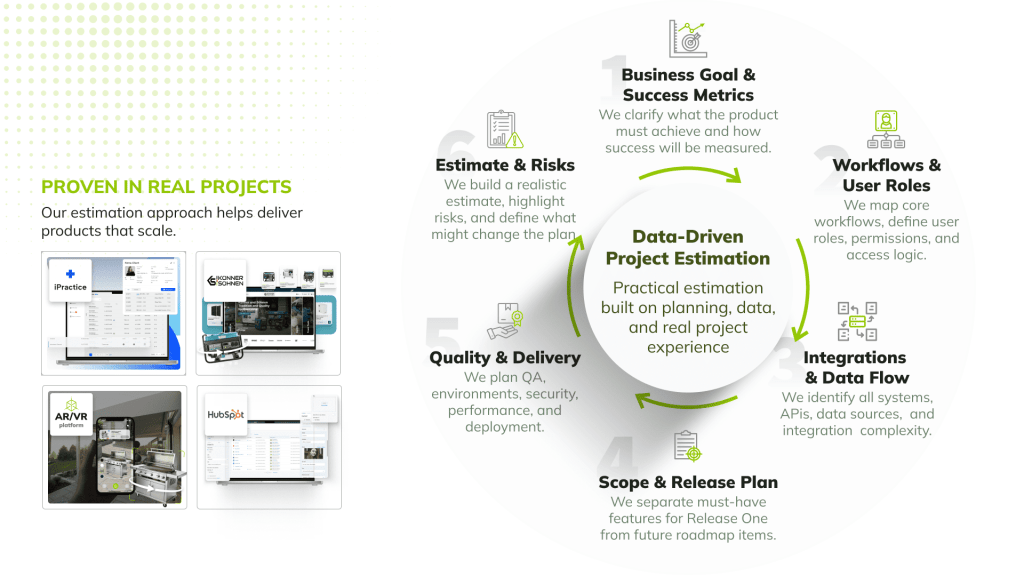
One Logic Soft treats estimation as part of product planning. The team reviews the business goal, maps workflows, checks technical constraints, separates release-one scope from roadmap items, prepares specification logic, and connects the estimate with QA, launch, and support planning. The same pattern is visible across the company’s case studies, from logistics and healthcare platforms to retail, Shopify Plus, HubSpot, and AR/VR projects. This approach fits custom software development projects where the product depends on business rules, integrations, data, user roles, and long-term ownership, not interface delivery alone.
For a company that already has a clear scope, One Logic Soft can move toward a structured proposal. For a company that has an idea, legacy process, or unfinished product vision, the better starting point is discovery, specification, and delivery model selection through software development cooperation models.
FAQ
How accurate can a software project estimate be before development starts?
It depends on the quality of inputs. A rough idea can support an early range. A mapped workflow, user role list, integration notes, release priorities, and acceptance criteria can support a much tighter estimate.
What should a software estimate include besides price?
It should include scope logic, assumptions, exclusions, team roles, milestones, risks, QA scope, delivery model, and change-control rules. Without these parts, the total number is hard to compare with other proposals.
Why do two vendors estimate the same project differently?
They may include different work. One proposal may cover business analysis, architecture, QA, project management, DevOps, documentation, and launch support. Another may price mostly coding. The comparison needs to check what is inside the estimate.
When is project specification needed before estimation?
Specification is useful when the product has several user roles, business rules, integrations, data flows, and acceptance criteria. It reduces ambiguity before development and gives the team a clearer delivery base.
Is Fixed Price possible before requirements are fully clear?
It is possible for a limited and stable scope. For unclear products, it is safer to fix the discovery or specification stage first, then estimate the build with fewer unknowns.


Have a project in mind?
Let's chat
Your request has been accepted!
In the near future, our manager will contact you.
Have a project to discuss?

Have a partnership in mind?