What to Ask Before Hiring a Software Development Company
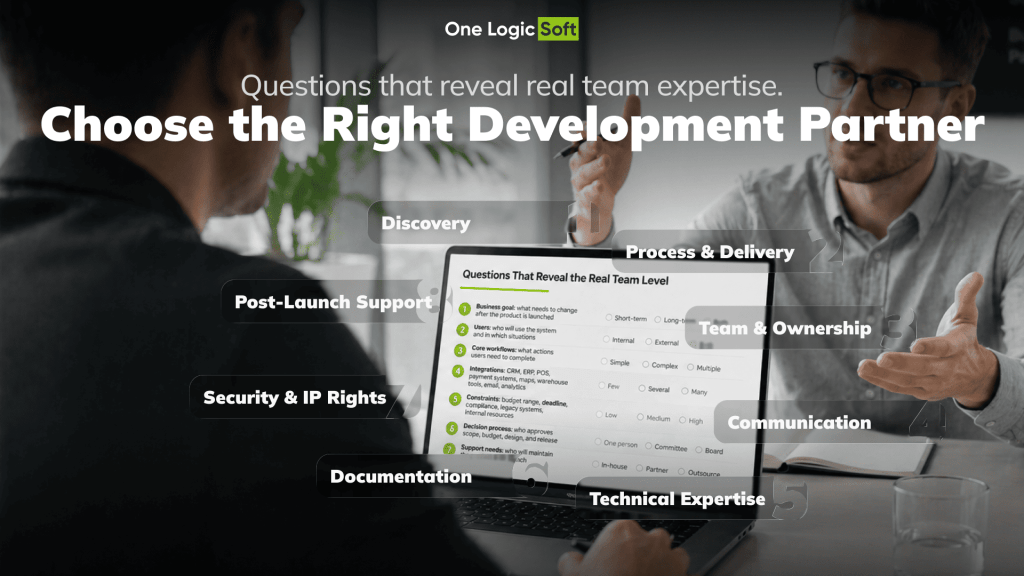
Choosing a software development company is not a simple comparison of prices, portfolios, technologies, and sales calls. Many vendors can show polished websites, confident presentations, attractive interfaces, and familiar tech stacks. The real difference appears later, when the team has to clarify unclear requirements, protect the budget, make architecture decisions, test the product, manage risks, and support the system after launch.
That is why vendor selection needs to be treated as a business risk decision before development begins. McKinsey research on large-scale IT projects found that large IT projects run 45% over budget, 7% over time, and deliver 56% less value than expected on average. The research covered more than 5,400 IT projects.
The goal is not to find the cheapest development team. The goal is to find a partner that can explain how they think, how they manage uncertainty, how they protect product quality, and how they stay accountable after the first release.
Why Portfolio and Price Are Not Enough
A portfolio can show what a team has delivered, but it rarely shows how the work was done. A clean interface can hide weak discovery, unstable architecture, rushed QA, poor documentation, unclear ownership, and fragile post-launch support.
When you review case studies, look beyond screenshots. Try to understand what business problem the project solved, what workflows were involved, which integrations were needed, how the first version was scoped, how quality was checked, and what happened after launch.
A weak vendor usually talks about visuals, features, and speed. A stronger team connects every project to business logic, product constraints, technical decisions, delivery process, and measurable results.
Prepare Your Project Context Before the First Serious Call
A strong vendor can shape requirements with you, but they still need context from your side. Before speaking with agencies, prepare the basics of your project. This makes the conversation more practical and shows whether the vendor asks the right questions.
Before the first detailed call, define:
- Business goal: what needs to change after the product is launched
- Users: who will use the system and in which situations
- Core workflows: what actions users need to complete
- Integrations: CRM, ERP, POS, payment systems, maps, warehouse tools, email, analytics
- Constraints: budget range, deadline, compliance, legacy systems, internal resources
- Decision process: who approves scope, budget, design, and release
- Support needs: who will maintain the product after launch
If a vendor gives a confident estimate without this context, they are not being fast. They are guessing.
Questions That Reveal the Vendor’s Real Level
The best vendor questions are not formal. They show how the team thinks, how they challenge assumptions, and how they manage risk before development starts.
How Would You Challenge Our Initial Brief?
This question shows whether the agency acts as an order-taker or as a real product partner.
A serious team will ask about business goals, user roles, edge cases, admin logic, integrations, data flows, release priorities, and operational limits. They may say that some features are too expensive for the first version. They may suggest a simpler flow, a staged roadmap, a discovery phase, and a smaller first release.
A weak team accepts everything too easily. If the answer is just “yes, we can build it,” with no meaningful questions, the real issues will likely appear after the contract is signed.
What Would You Build First?
This question reveals product thinking. A capable team does not push every idea into the first release.
For a booking platform, the first release may focus on doctor selection, time slots, confirmations, and admin scheduling. For a retail app, it may focus on scanning, cart logic, checkout, and loyalty basics. For a logistics system, it may focus on order intake, dispatching, shipment tracking, and warehouse coordination.
A strong answer explains the core user flow, first-release scope, delayed features, dependencies, and expected risks. A weak answer sounds too broad. If the agency says everything can be built at once, ask how they will protect timeline, QA, and budget.
Who Will Actually Work on the Project?
Sales calls often include senior people. Delivery can involve a different team. This is one of the most practical questions in outsourcing partner selection.
Ask who joins the project after signing. You need clarity on the project manager, tech lead, frontend developers, backend developers, QA engineer, UI/UX designer, DevOps engineer, solution architect, and business analyst when those roles are relevant.
You do not need every role on every project. You need clear ownership. The vendor has to explain who plans the work, who leads architecture, who checks quality, who manages deployment, who joins demos, and who becomes the escalation contact when decisions are stuck.
How Do You Estimate Timeline and Budget?
A reliable estimate is not a magic number. It is a set of assumptions.
A professional team explains what is included in discovery, design, development, QA, deployment, integrations, data migration, documentation, and support. The estimate needs to show risks, dependencies, and possible trade-offs. If the team gives an exact price from a vague brief, the risk is already visible.
The best estimate usually sounds less polished but more honest. It explains what is known, what is unclear, which assumptions affect the budget, and how scope changes will be handled.
What Happens When Requirements Change?
Requirements will change. The real question is whether the vendor has a process for change.
A mature team will talk about backlog control, change requests, impact assessment, sprint planning, decision logs, and approval before work begins. A weak vendor will simply say they are flexible. Flexibility without process turns into hidden scope growth, scattered messages, rushed decisions, and budget tension.
Technical Due Diligence for Non-Technical Buyers
You do not need to be an engineer to evaluate technical maturity. You need to see whether the vendor can explain technical decisions in business language.
Why Do You Recommend This Technology Stack?
A strong team does not choose a stack just because it is familiar. They connect technology with product goals, performance needs, maintenance cost, available talent, integration plans, security, and future support.
If the answer sounds like “we always use this stack,” ask for alternatives. A mature team can explain why one approach fits the project better than another.
How Do You Organize Code Review and QA?
Code quality is not an internal technical detail. It affects maintenance cost, release stability, future development speed, and technical debt.
Ask how the team reviews pull requests, writes acceptance criteria, prepares test cases, tracks bugs, runs regression checks, and separates staging from production. QA needs to be part of delivery, not a final panic stage before launch.
If developers test everything alone, bugs are tracked in chat, and staging does not exist, the project may look cheaper at first but become more expensive later.
How Do You Prepare for Deployment?
Deployment often reveals weak process. Ask how the vendor manages environments, access, backups, releases, rollback plans, monitoring, and release notes.
A professional team separates development, staging, and production environments. Deployment steps are documented. Production access is limited. Release responsibility is clear. If something breaks, the team knows who reacts, what gets checked, and how the previous stable version can be restored.
Security, Ownership, and Documentation
Security questions need to appear before the first sprint. This matters for systems that handle customer data, payments, accounts, roles, internal operations, logistics data, healthcare-related workflows, and third-party integrations.
The NIST Secure Software Development Framework gives a structured set of secure software development practices that can be integrated into the software development lifecycle. It is useful for engineering teams and for buyers who need a shared language when discussing security with suppliers.
How Do You Protect Code, Data, and Access?
Ask how the vendor manages repositories, credentials, role-based access, production permissions, secrets, third-party libraries, and cloud services.
A strong answer covers protected repositories, limited production access, no secrets in code, NDA terms, IP ownership, and secure handling of third-party services. A weak answer relies on shared credentials, unclear repository access, and no visible access policy.
Who Owns the Source Code?
This needs to be clear before work begins.
The agreement needs to state who owns the source code, when repository access is granted, where the code is stored, what happens if cooperation ends, which third-party licenses are involved, and who owns design files, documentation, deployment assets, and related materials.
If the vendor avoids this topic, hesitates to grant repository access, and keeps delivery assets under unclear control, that is a serious warning sign.
What Documentation Will We Receive?
Documentation protects the client from vendor lock-in. It reduces support cost and makes future development easier.
Ask what will be documented:
- Architecture notes
- API logic
- Admin workflows
- Deployment process
- Environment setup
- Integration logic
- Known limitations
- Post-launch backlog
A weak vendor treats documentation as an optional extra. A mature team treats it as part of delivery.
Warning Signs You Should Not Ignore
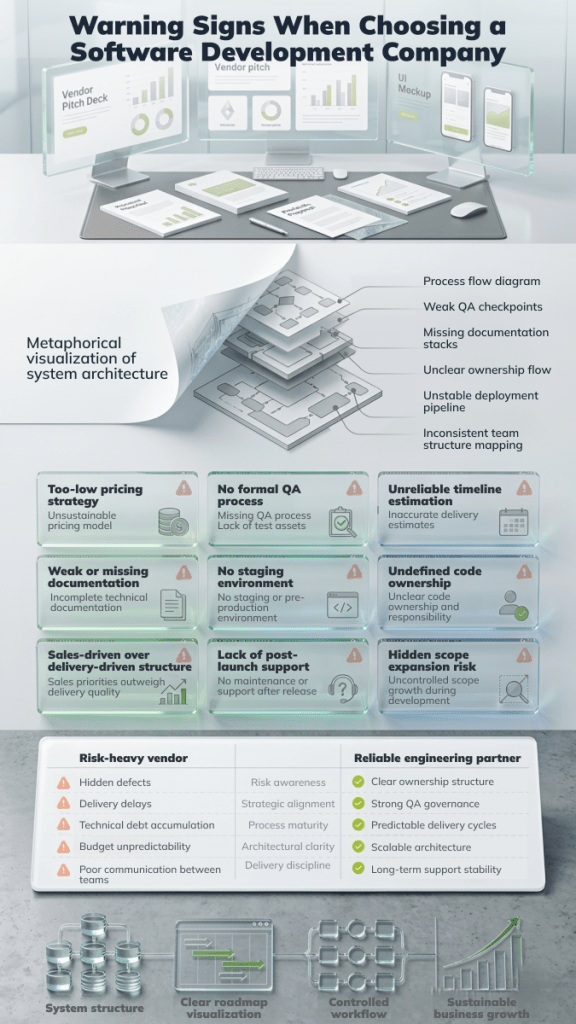
Some risks are visible before any code is written. A suspiciously low price is rarely just a discount. It often means something has been removed from the process: discovery, QA, senior review, documentation, security, deployment planning, project management, support.
Lack of project tracking is another signal. The exact tool matters less than transparency. Jira, Trello, Linear, ClickUp, GitHub Projects, and similar systems can all work. What matters is whether tasks, backlog, bugs, demos, risks, and decisions are visible.
Limited access to technical people can become a problem during architecture choices, integrations, blockers, and release planning. You do not need daily calls with every engineer, but you need access to the right person when technical decisions affect the business.
A strong sales team with a weak delivery team is another common risk. Ask who leads the project after the contract is signed, who reviews architecture, who checks code, who runs demos, and who owns release quality.
The clearest warning sign is a vendor that agrees with every idea. A capable team will challenge weak assumptions. They may say that a feature is too expensive, unclear, risky, unnecessary for the first release, and harmful to user experience. Honest pushback is a positive signal.
Practical Vendor Scorecard
Use this scorecard after each vendor call. Rate every category from 1 to 5 and compare vendors by answer quality, not by sales confidence.
| Category | What a strong vendor explains | Risk signal |
| Discovery | Goals, users, workflows, integrations, constraints | Price and timeline from a vague brief |
| Scope | First release logic, delayed features, dependencies | Everything is pushed into one release |
| Team | Roles, seniority, delivery lead, QA, escalation | Vague answer about “our team” |
| Architecture | Stack choice, performance, maintenance, support | Stack chosen by habit |
| QA | Code review, staging, regression checks, bug tracking | Testing left to developers alone |
| Security | Access control, repositories, credentials, ownership | Shared access and no policy |
| Communication | Demos, backlog access, reports, decision history | Updates through random messages |
| Documentation | Architecture, APIs, deployment, admin flows | Documentation treated as optional |
| Support | Warranty, bug flow, monitoring, handover | Launch treated as the end |
| Case relevance | Similar workflows and technical scope | Generic screenshots with no context |
A vendor with a lower price but weak scores in QA, security, ownership, and communication can become more expensive after development begins.
How Case Studies Reveal the Real Delivery Level
Case studies are useful when they reveal how a team thinks. A strong case study shows client context, business challenge, scope, technical solution, workflow logic, integrations, results, and future product direction.
The One Logic Soft case studies section includes projects across logistics, retail, healthcare booking, Shopify Plus commerce, HubSpot CMS, and AR/VR product experience. These examples show different types of operational logic behind custom development work: order management, mobile checkout, appointment scheduling, regional commerce, CRM-connected websites, and product visualization.
For a logistics company, a relevant case study should show more than a dashboard. It needs to explain order intake, warehouse coordination, dispatching, delivery windows, shipment tracking, and long-term support. The UVK Order Management System case is useful for this type of evaluation.
For retail, the Scan&Go Mobile Self-Checkout case shows how a focused MVP can reduce checkout friction through scanning, cart logic, in-app payment, loyalty features, and rollout planning.
For healthcare booking, the i-Practice platform shows how a simple patient-facing flow can sit on top of scheduling logic, PDFs, email notifications, CSV imports, payments, and admin coordination.
For e-commerce, the Könner & Söhnen Shopify Plus case shows why multi-market commerce needs more than storefront design. Regional stores, language versions, B2B logic, catalog rules, pricing, SEO migration, and automation all affect vendor evaluation.
When One Logic Soft Fits the Project
One Logic Soft fits projects where the product is tied to real business workflows, not just interface delivery. This includes web platforms, mobile applications, logistics systems, retail apps, e-commerce ecosystems, HubSpot CMS projects, AR/VR product experiences, and internal business tools.
For companies planning custom software development, the strongest fit is usually a project where discovery, workflow logic, integrations, QA, scalability, and support matter from the first stage. The team needs to understand what needs to be built and how the product will operate inside the business.
If your company is comparing software development vendors, use the questions above before signing a contract. Then check real case studies to see whether the vendor has already handled similar technical and business scope in practice.
FAQ
How to choose a software development company?
Choose a software development company by checking discovery process, team structure, technical thinking, QA, security, documentation, ownership, communication, case studies, and post-launch support. Portfolio and price are useful, but they are not enough.
What questions should I ask a dev agency?
Ask how the agency challenges your brief, estimates timeline and budget, manages scope changes, assigns the team, organizes QA, protects data and code, documents the system, and supports the product after launch.
What is software development due diligence?
Software development due diligence is the process of checking a vendor’s technical, operational, security, legal, and delivery readiness before signing a contract. It reduces risk before budget, timeline, and product decisions become harder to change.
What needs to be included in a vendor evaluation checklist?
A vendor evaluation checklist needs to cover discovery quality, team roles, estimation logic, project management, architecture decisions, QA, security, IP ownership, documentation, communication, relevant case studies, and support model.
How do I compare outsourcing software development partners?
Compare outsourcing partners by the specificity of their answers. A strong partner explains risks, assumptions, scope trade-offs, team roles, testing, security, documentation, and support. A weak partner gives generic promises without a clear delivery process.
Why is the cheapest software development company often risky?
The cheapest offer may exclude discovery, QA, senior review, documentation, security work, deployment planning, support, and project management. These missing parts often return later as bugs, delays, rework, and technical debt.
Why are case studies useful during vendor selection?
Case studies show whether the vendor has worked with similar workflows, integrations, product types, and business constraints. They let you judge delivery experience beyond sales claims.


Have a project in mind?
Let's chat
Your request has been accepted!
In the near future, our manager will contact you.
Have a project to discuss?

Have a partnership in mind?