The OLS Process Under the Microscope: From Idea to Release in 6 Steps (PoC → MVP → Prod)
At OneLogicSoft, we design and deliver complex digital systems that operate under real-world pressure, including AI-assisted logistics platforms, secure fintech infrastructures, high-load retail systems, and enterprise mobile applications. Our teams unite product thinking with a proven engineering methodology built on Java, PHP, Node.js, React and React Native, microservices, and DevOps practices across AWS and Azure. The result is a six-step lifecycle known as the OLS Process, which takes ideas from hypothesis to full production while ensuring reliability, data protection, and regulatory readiness.
Below is a detailed look at how this process works in practice, based on real client projects in logistics, retail, banking, automotive, and other industries.
1. Start with Decisions, Not Features
Every successful product begins with clarity about which decisions can be made quickly and which require caution.
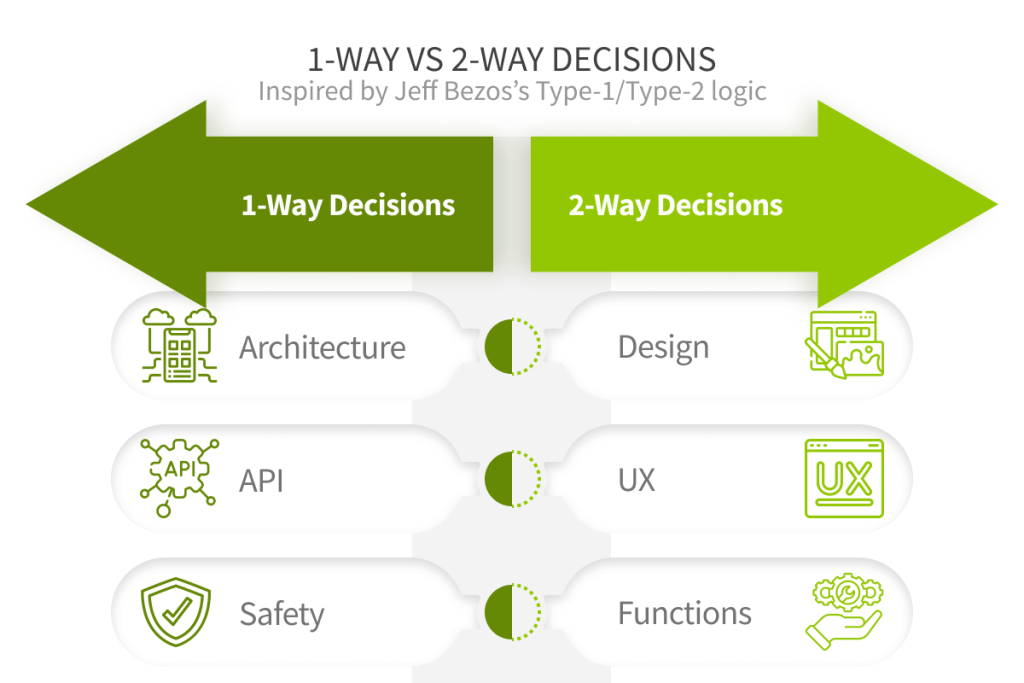
Following Jeff Bezos’s logic, OLS classifies all design choices as Type-1 (irreversible) or Type-2 (reversible).
Early in PoC and MVP, most decisions must stay reversible to avoid locking architecture prematurely. Choices like domain modeling or API contracts, which are harder to change, go through extended review.
At OLS: each stage is labeled with 1-way or 2-way markers. Only 1-way decisions require formal justification.
This approach accelerates delivery while safeguarding true points of no return.
2. Measure Outcomes, Not Activity – DORA Metrics + Experimental Discipline
Speed without control is chaos.
OLS follows the Four DORA Metrics Deployment Frequency, Lead Time, Change Failure Rate, and MTTR as the backbone of every pipeline.
2024 studies show that speed and stability correlate when teams integrate measurement directly into CI/CD rather than treating it as reporting afterthoughts.
For MVP phases, OLS integrates experimentation frameworks with clear evaluation standards.
At OLS:
- Define one OEC (Overall Evaluation Criterion) e.g., active users per week or revenue per active account.
- Add 3-5 guardrails such as latency, crash rate, churn, fraud, or SLA violations.
- Every experiment includes an SRM check (Sample Ratio Mismatch); mismatched samples trigger auto-rejection to avoid false positives.
3. The PoC Trap – Evolve, Don’t Repaint
One of the most expensive errors in software development is deploying PoC code into production.
Instead, OLS applies the Strangler Fig Pattern gradually surrounding the old system with new services, routing traffic step by step, and retiring obsolete components without downtime.
At OLS: every PoC ends with a Strangler Card that defines:
- which endpoints migrate first,
- how routing will transition,
- what metrics confirm safe cutover.
In fintech and logistics projects, we begin with read-only traffic and then move to controlled shadow traffic before enabling mutations.
4. Early Testing Pays – The Cost of Change Is Exponential
The cost of fixing a defect rises sharply with each stage of maturity.
OLS mitigates this by concentrating architectural verification early: scalability, data consistency, and schema evolution are tested before MVP.
OLS uses a PoC risk checklist:
- peak load and degradation behavior,
- limits of external APIs,
- backward-compatible schema migrations.
If any answer remains “unknown,” a micro-experiment is launched before proceeding.
5. Developer Experience as the Backbone – Trunk-Based, Flags, and CI/CD
MVP teams often fail due to merge conflicts and long branches.
At OLS, we enforce trunk-based development combined with feature flags short-lived branches, small commits, and automated pipelines.
Our standards:
- Flag-first a feature flag is created before the code.
- Branches live hours, not weeks.
- CI runs automated tests across all active flag combinations.
This engineering discipline is what keeps rapid delivery sustainable.
6. Regulatory Gates Matter – Especially for AI (2025–2027)
Regulation now moves as fast as technology.
The EU AI Act is entering force: general provisions apply today, duties for GPAI/foundation models start in August 2025, and high-risk domains are fully regulated by 2026–2027.
Under GDPR, many data-driven projects require a Data Protection Impact Assessment (DPIA) before release.
At OLS:
- During the Idea phase, each project is assigned an AI Act risk class and corresponding data policy.
- At the MVP → Prod gate, a DPIA is mandatory for any scenario involving profiling, sensitive data, or public monitoring.
Ignoring these gates leads to release delays and financial penalties so they’re built into the lifecycle.
How These Principles Map to the Six OLS Steps
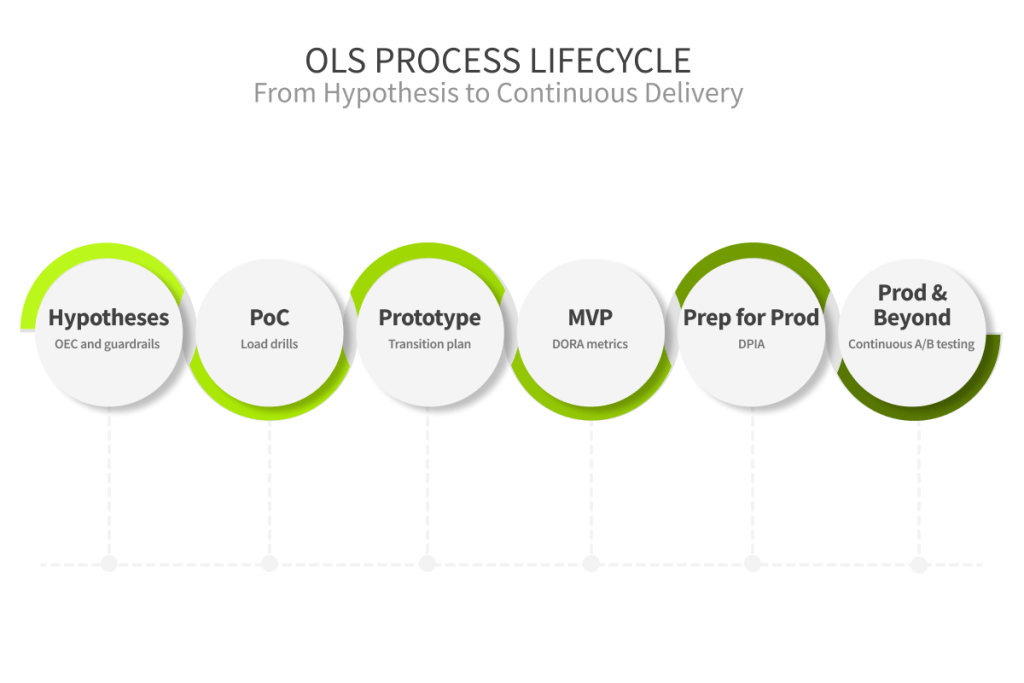
| Step | Objective | Key Deliverables & Gates |
| 1. Idea / Hypotheses | Define business value and decision types | OEC + guardrails, AI/GDPR class, experiment plan |
| 2. PoC | Test technical feasibility & architecture risks | Load drills, degradation scenarios, Strangler Card |
| 3. Prototype / Pilot | Validate UX and process logic | Transition plan to MVP, 1-way decisions list |
| 4. MVP | Deliver core value with full telemetry | Four DORA metrics, SRM gate, flag architecture |
| 5. Prep for Prod | Ensure reliability and compliance | SLOs, rollback plan, DPIA for sensitive use cases |
| 6. Prod & Beyond | Scale and refine | Continuous A/B tests with OEC + guardrails, tech-debt roadmap |
Anti-Patterns and How OLS Detects Them
- PoC in production: demo code released causes spikes in CFR and MTTR.
Prevention: always route via a façade and replace modules gradually. - Fake MVP: overloaded with features but no clear signal.
Prevention: define one measurable OEC and enforce guardrails. - Disconnected metrics: tracked manually in BI slides.
Prevention: embed Four Keys telemetry in CI/CD. - Branch chaos: long-living branches cause regressions.
Prevention: trunk-based model and sprint-level flag cleanup. - Regulatory blind spots: no DPIA or AI classification.
Prevention: early regulatory screening and assurance artifacts.
Performance Targets
- MVP phase: deploy daily or weekly; Lead Time < 7 days, CFR ≤ 20%, MTTR < 24 h typical for mature B2B pipelines.
- Production phase: error budget governs release cadence. When it’s exceeded, teams pause new features and focus on reliability standard SRE discipline.
What Makes the OLS Process Different
- Decision matrix discipline: structured 1-way/2-way decisions keep velocity high with accountability.
- Experimentation with integrity: OEC + SRM + guardrails ensure trustworthy data.
- Incremental modernization: Strangler migration prevents legacy lock-in.
- Developer-centric pipelines: trunk-based, flag-driven workflow eliminates bottlenecks.
- Compliance built-in: AI/GDPR gates ensure readiness for EU regulation before release.
FAQ: PoC, MVP, and Production at OLS
What is the main difference between a PoC and an MVP?
A Proof of Concept (PoC) confirms that a technical idea can be implemented. A Minimum Viable Product (MVP) proves that the idea has real market and user value. At One Logic Soft, these stages are intentionally separated to validate both the technology and the business potential before scaling further.
How long does it take to move from MVP to full production?
For medium-scale projects, the transition typically takes two to four months, depending on infrastructure complexity, compliance scope, and integration needs. Larger enterprise platforms may extend this period to ensure stability and data protection readiness.
Why should teams avoid skipping the PoC phase?
Bypassing the PoC often leads to hidden architectural flaws and rework later in development. Based on OLS internal metrics from more than forty successful projects, skipping this stage can triple the cost and time required to reach production quality.
What happens once the product is released?
After release, the product enters a continuous improvement loop. OLS tracks performance through DORA metrics, runs A/B experiments, and collects customer telemetry to guide future iterations. Support, optimization, and scaling remain integral parts of the same delivery process.
How does OLS use the Strangler Fig approach in real projects?
Instead of rewriting legacy systems all at once, OLS progressively replaces them by routing specific services or endpoints through new modules. This allows seamless migration, minimizes downtime, and ensures data consistency. The Strangler approach has proven effective for fintech integrations and logistics modernization where operations cannot be interrupted.
How does the OLS Process ensure compliance with GDPR and the EU AI Act?
Compliance is built into the lifecycle from the earliest phases. Each project is assigned a risk class during the idea and PoC stages, while Data Protection Impact Assessments (DPIAs) are performed before the product moves to production. This proactive framework ensures that every AI-driven or data-sensitive solution meets current and upcoming regulatory standards.
Bringing It All Together: Why the OLS Process Works
The OLS Process is not just a sequence of development stages but a structured framework that connects engineering discipline, measurable results, and forward-looking product strategy. It brings together data-driven decision-making, continuous experimentation, and a clear understanding of regulatory and technical environments.
Through this approach, OneLogicSoft turns initial concepts into reliable, compliant, and scalable digital products that continue to grow and adapt long after release. Each project becomes a cycle of learning and refinement, guided by transparency, precision, and collaboration between our teams and our clients.
If you would like to understand how this process can accelerate your own product development, explore our logistics software case study or see how OneLogicSoft stands out among retail software development companies by creating scalable, efficient, and user-focused digital solutions. Contact our team to discuss how your idea can progress through all six stages of the OLS Process.


Have a project in mind?
Let's chat
Your request has been accepted!
In the near future, our manager will contact you.
Have a project to discuss?

Have a partnership in mind?