How Digital Goods Marketplaces Handle Non-Instant Delivery in 2026
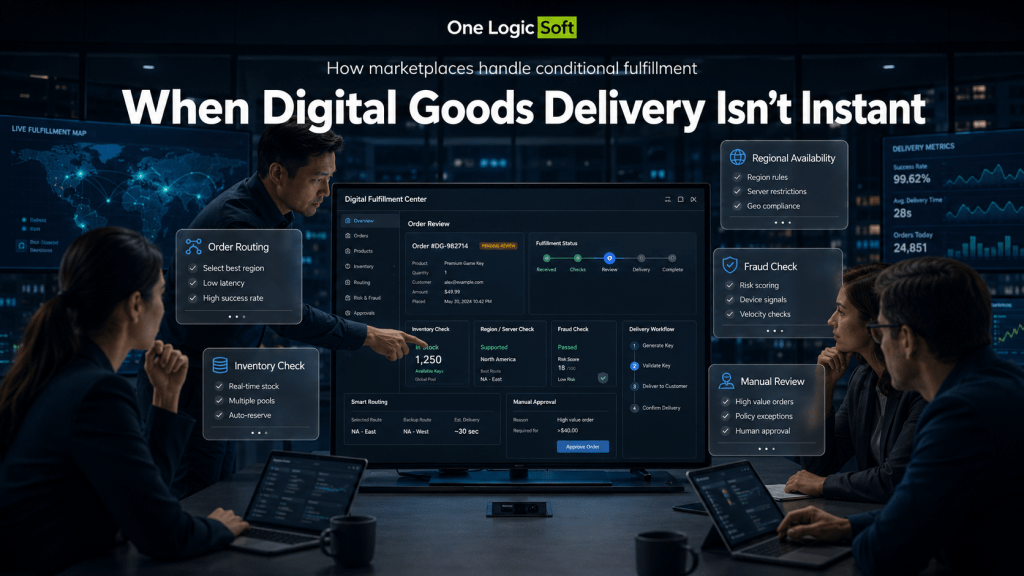
According to Newzoo, the global games market closed 2025 at $201.6 billion, crossing the $200 billion mark for the first time. Baymard puts the average e-commerce cart abandonment rate at 70.19%, and Juniper Research estimates that fraudulent digital-goods transactions will rise from $10.4 billion in 2025 to $27 billion by 2030.
Taken together, these numbers point to one practical truth: digital commerce may look simple on the surface, but fulfillment behind the checkout can be far more operational than most customers expect.
Most people hear the phrase digital product and picture something immediate. A file is downloaded, a subscription is activated, or a license key appears on screen. The transaction feels complete as soon as payment goes through.
That assumption stops working when the product depends on a live external system, a region, a server, a player profile, a trading rule, or a delivery route that cannot be completed by software alone. In those cases, checkout is not the end of fulfillment. It is the point where fulfillment begins.
This is where many digital marketplaces stop looking like classic e-commerce and start acting more like operational software. The customer still expects a smooth purchase, but behind the page the platform may need to verify order data, confirm product availability for a specific setup, assign the order to the right queue, wait for customer presence, and record completion in a way support can later review.
That is a different problem from selling a downloadable file. It also explains why standard storefront logic is often too shallow for specialized digital commerce.
Why Digital Goods Are Not Always Infinite
In retail, inventory usually means a number. A product is in stock or out of stock. A warehouse has twelve units left, and the site reflects that count.
In a digital marketplace, availability can depend on a chain of conditions rather than a single quantity. A product may be available for one region but not another. One delivery method may work on one platform and fail on the next. A buyer may need a specific account feature enabled before delivery can happen at all. The offer exists, but the order is still not fulfillable until several variables line up.
That changes the meaning of stock.
A marketplace in this category is not really managing one pool of inventory. It is managing combinations: product, platform, region, delivery method, timing, supplier access, and operator capacity. When teams try to run that through a simple store backend, the same pattern appears again and again. The product page says one thing, support says another, and the fulfillment team has its own separate reality.
The issue is not lack of effort. The issue is that a standard product model was never built for this kind of operational logic.
Inventory Turns Into a Rules Problem
Once availability depends on multiple conditions, the real task is no longer just counting stock. The real task is evaluating whether a given order actually fits the rules of fulfillment.
That may sound technical, but the business effect is simple. If the rules are weak, the platform accepts orders it cannot complete cleanly. If the rules are too rigid, the site hides valid purchase paths and leaves revenue on the table. The system needs to know when to approve an order, when to pause it, and when to route it for review.
This is why real-time data matters so much. Product data, order data, current availability, and delivery conditions cannot live in isolated tools for long. Once they drift apart, the customer sees a polished storefront and a messy post-purchase experience.
Checkout Is Part of the Operations Layer
For many digital marketplaces, the checkout form does more than collect billing information. It gathers the fields the fulfillment team needs in order to act.
That can include region, server, platform, character name, selected mode, preferred delivery window, or confirmation that the customer can receive the order through the required method. None of this is decorative form design. These fields are part of the order itself.
If the customer chooses the wrong region, enters the wrong character name, or skips an operational prerequisite, the order may still be paid but not actually ready for delivery. In physical commerce, that is similar to receiving payment for a parcel with an incomplete address. The sale exists, but the fulfillment path does not.
Good validation prevents avoidable errors
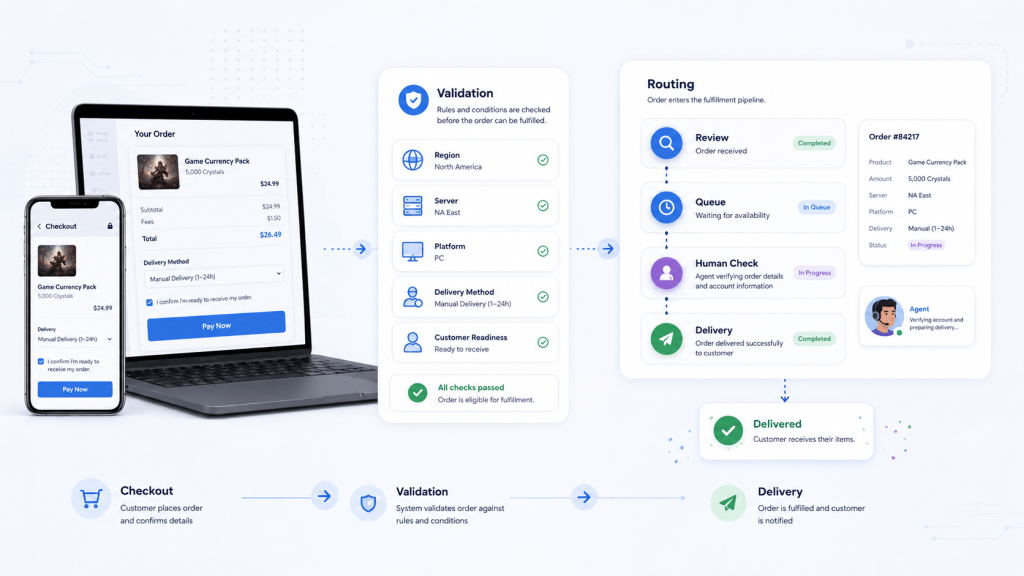
This is why specialized marketplaces need stronger validation before payment. The form should not simply collect data. It should block obvious failure points before they become support tickets.
When the system shows only valid options for the selected region, hides unsupported methods, and flags missing prerequisites before payment, it is already doing fulfillment work. In this model, checkout is not just a sales screen. It is the first operational filter.
The Hard Part Is Not the Standard Order
The simplest orders are rarely the reason a team needs custom workflow logic. The pressure comes from exceptions.
A standard order with valid data, confirmed payment, and a normal delivery path can often move with limited intervention. The real cost appears when something is incomplete, unclear, delayed, or unusual. That is where staff time disappears.
An operator waits for a customer response. Support discovers that the selected server is wrong. A payment clears, but stock for that route is no longer available. A supplier can deliver, but not in the usual window. A customer changes a key detail after the order has already entered the queue.
These are not theoretical edge cases. For many marketplaces, they are a daily part of the workload.
Automation Works Best Around Human Decisions
This is where the common argument about automation often goes wrong. The question is not whether software can remove people from the process entirely. In marketplaces with live external dependencies, that is often the wrong target.
A better question is this: which parts of the workflow are repetitive enough for automation, and which moments still need a person because the risk or ambiguity is too high?
Software can validate data, reserve stock, assign orders, send reminders, update statuses, and record every action. A person may still need to confirm an unusual case, coordinate with the customer, or step in when the default route fails.
That split is more practical than the old choice between manual work and full automation. The platform handles preparation and tracking. People handle the moments where judgment still matters.
Why This Matters in a Multi-Game Marketplace
A multi-game marketplace makes the problem easier to see because product logic changes from one category to the next.
One order may depend on region and server. Another may depend on a marketplace listing. A third may require the buyer to be online for a direct handoff. Even when the storefront looks consistent, the fulfillment model under each product can be very different.
That is one reason CoinLooting is a useful example. From the outside, it looks like a digital goods store. In practice, many products depend on structured order inputs and manual handling rather than instant automated delivery. The product page is only one layer. The real system lives in how product rules, order routing, customer coordination, and delivery confirmation connect behind the scenes.
Where Standard E-Commerce Stops Being Enough
Standard e-commerce works best when payment, product access, and confirmation follow a predictable path.
| Fulfillment model | What usually matters | What breaks first |
|---|---|---|
| Instant digital delivery | Payment, product access, automated confirmation | File access, license activation, payment issues |
| Conditional digital fulfillment | Region, server, delivery route, customer readiness, operator capacity | Wrong order data, stock mismatch, queue delays, manual coordination |
When these variables decide whether an order can move forward, one generic checkout and one generic order status are no longer enough. The platform needs a configurable product model.
Each product category may require its own fields, rules, and post-purchase steps. The software needs to know which data matters, which route is valid, and when the order can move forward without review. Without that logic, the platform starts depending on team memory and chat messages instead of system behavior.
That is usually the point where growth creates friction. More traffic does not simply mean more sales. It means more exceptions moving through a weak workflow.
Build the Operational Core First=
It is tempting to jump straight into AI, recommendation engines, predictive timing, or automated support assistants. Those ideas become more useful after the base workflow is stable. In practice, the better starting point is often a stronger custom software development foundation that reflects the real fulfillment flow instead of forcing it into a generic storefront model.
The real starting point is simple: identify where the marketplace loses time, trust, or visibility between payment and completion. In most cases, the answer leads to the same operational core:
- Shared order states that match the real fulfillment process and stay visible to support, operations, and delivery teams.
- Pre-payment validation that checks region, server, platform, delivery method, and customer prerequisites.
- Order routing rules that assign each purchase to the correct queue, supplier, operator, or review process.
- Role-based permissions that control who can change sensitive order details, approve exceptions, and confirm delivery.
- A complete audit trail that records status changes, customer updates, staff actions, and delivery confirmation.
- Operational reporting that separates delays caused by customers, stock availability, staffing, payment review, and product setup.
When these pieces are connected, the platform can see where orders become blocked and which parts of the workflow are ready for automation. Without that base, advanced features rest on weak ground.
FAQ
What makes a digital goods marketplace harder to manage than a standard online store?
Many orders depend on live conditions rather than fixed inventory alone. Payment may be only one part of fulfillment. Region, server, delivery method, buyer readiness, and operator availability can all affect whether the order can move forward.
Why is checkout so important in this kind of marketplace?
Checkout is often the first operational checkpoint. If the system collects the wrong data or lets unsupported combinations pass through, support and fulfillment teams end up fixing avoidable mistakes after payment.
Can this kind of workflow be fully automated?
Some parts can. Validation, routing, reminders, and status updates are strong candidates for automation. Orders with unusual conditions, missing data, or higher risk often still need a person in the loop.
When does a company need custom software instead of a standard e-commerce setup?
That point usually comes when the catalog looks simple on the surface, but fulfillment depends on conditional logic that a generic store backend cannot model cleanly. If orders still depend on memory, chat messages, and manual fixes, the store has already outgrown a standard setup.
Digital Commerce Stops Being Simple When Fulfillment Is Conditional
A marketplace with conditional fulfillment needs an operational layer that understands when an order is valid, when it is ready, when it is blocked, and who needs to act next.
When a digital goods marketplace gets this layer right, the customer sees fewer surprises, support spends less time correcting avoidable mistakes, and the fulfillment team works from a system instead of scattered messages. The sale still starts at checkout, but the real product is the workflow that carries it to completion.


Have a project in mind?
Let's chat
Your request has been accepted!
In the near future, our manager will contact you.
Have a project to discuss?

Have a partnership in mind?