How to budget for 2026 AI agents without underestimating integration costs
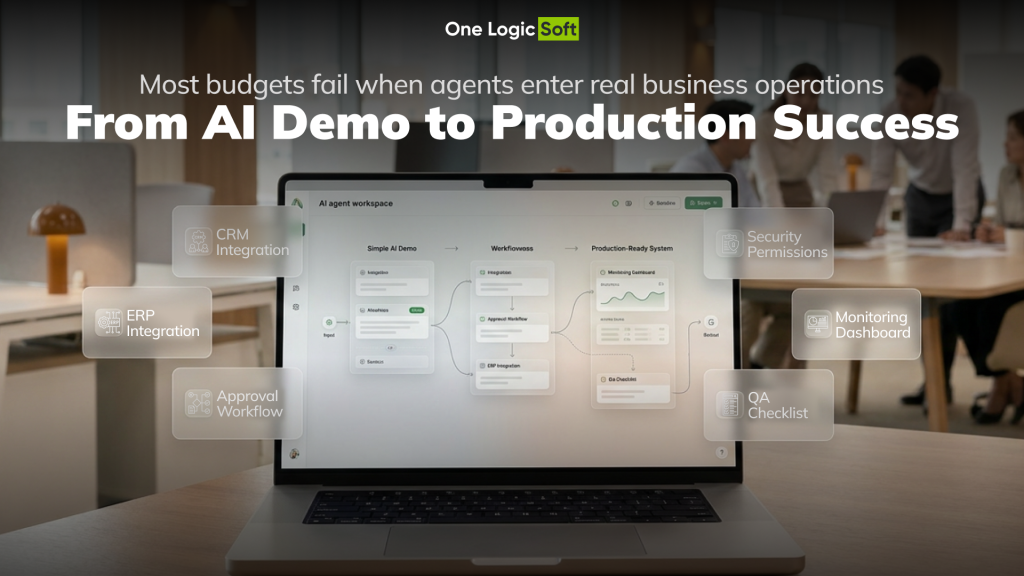
An AI agent demo can look simple. A prompt, a model, a few documents, one connector, a clean test scenario, and the agent seems ready to work.
The real cost appears later. The agent needs to read business data, respect permissions, call internal systems, handle exceptions, avoid unsafe actions, keep logs, pass QA, stay within usage limits, and improve after release. At that point, the project is no longer about “adding AI.” It becomes a software delivery project with workflow logic, integrations, security, testing, monitoring, and product ownership.
That is why AI agent development cost in 2026 is hard to price from a short idea alone. Deloitte’s 2026 State of AI in the Enterprise report notes that worker access to AI rose by 50% in 2025, and the number of companies with at least 40% of AI projects in production is expected to double within six months. Scaling creates a different budget question. The problem is rarely the model alone. The budget breaks when the agent enters real operations without clear scope, clean data, controlled access, and measurable outcomes.
This guide explains what drives AI agent development cost, how to separate a small prototype from a production system, and what a company needs to define before asking for an estimate.
Why AI Agent Cost Is Not Just Model Cost
A business does not pay only for the LLM. It pays for the system that lets the agent work safely inside company operations.
A basic AI assistant can answer questions from a document. A real AI agent can receive a task, check context, choose a tool, call an API, update a record, create a draft, request approval, escalate a risky case, and leave a trace of what happened. Each of those abilities adds product work, engineering work, QA work, and long-term support work.
This is why AI agent development belongs close to custom software development when the agent touches CRM, ERP, logistics platforms, retail systems, order management, customer portals, internal dashboards, product databases, support tools, documents, payments, maps, inventory, user roles, and reporting.
The budget depends on what the agent is allowed to do:
- answer from approved knowledge
- classify incoming requests
- prepare a draft for review
- recommend the next action
- call tools and update records
- coordinate several workflow steps
- make low-risk decisions automatically
- hand off high-risk decisions to people
The same “AI agent” label can describe very different systems. A customer support assistant with one knowledge base is not priced like a logistics exception agent connected to orders, documents, statuses, maps, dispatch workflows, and accounting exports.
The First Cost Driver: Business Workflow Scope
The first budget question is not technical. It is operational: which workflow should the agent own?
A small agent with one clear job is easier to estimate. For example, it classifies support tickets, extracts fields from invoices, checks product content gaps, drafts customer replies, or summarizes shipment delays. A broader agent that moves across several departments needs more planning, permissions, integrations, testing, and monitoring.
This is why project planning for web and mobile apps matters before development starts. The team needs to define the task boundary, the user roles, the process states, the exception paths, and the point where the agent stops and a person takes over.
Scope becomes expensive when the agent is expected to “understand everything” without a clear workflow. A better first release has a narrow outcome:
- reduce ticket triage time
- speed up document review
- prepare order status updates
- flag risky invoices
- enrich product records
- suggest stock transfer actions
- prepare sales follow-up notes
A focused agent creates a measurable result. A vague agent creates endless refinement.
The Second Cost Driver: Data and Knowledge Layer
Many AI agent projects turn into data cleanup projects. The agent needs reliable input before it can act with confidence.
For a retrieval-based agent, the team needs to prepare knowledge sources: policies, manuals, FAQs, contracts, product data, support tickets, order histories, delivery statuses, technical documents, CRM notes, and internal playbooks. For a workflow agent, the team also needs live business data from operational systems.
Cost grows when data is scattered across spreadsheets, legacy databases, PDFs, email threads, CRM fields, ERP exports, shared drives, and third-party tools. The team needs to define the source of truth, remove duplication, structure fields, manage access rights, and decide what the agent can read.
A weak data layer creates three budget problems:
- more development time, since engineers have to normalize messy sources
- more QA time, since outputs need extra validation
- more support time, since users lose trust when the agent gives inconsistent answers
This is where a clear project specification protects the estimate. It turns a loose idea into data sources, access rules, accepted outputs, edge cases, integration points, and release-one limits.
The Third Cost Driver: Integrations and Tool Access
An AI agent becomes useful when it can act through tools. That is also where cost rises.
A support agent may need access to the help desk, CRM, order history, knowledge base, and notification system. A logistics agent may need order statuses, route data, document storage, warehouse events, driver updates, maps, and accounting data. A retail agent may need POS, inventory, loyalty, pricing rules, product catalog, returns, and store operations.
Every integration adds work around authentication, permissions, API limits, data mapping, error handling, retries, logging, and fallback states. Some systems expose clean APIs. Others rely on old exports, custom connectors, middleware, manual uploads, or undocumented business logic.
Earlier work on integration project timeline risks applies directly to AI agent estimation. If the agent depends on three unstable systems, the estimate needs to include integration risk, not only AI development.
AI Agent Development Cost Drivers
The table below shows the main budget drivers and the questions a company should answer before asking for a quote.
| Cost driver | What affects the budget | Risk if skipped | Planning question |
| Workflow scope | Number of tasks, roles, states, approvals, exceptions | The agent becomes too broad and hard to finish | What exact workflow should release one cover? |
| Autonomy level | Drafting, recommending, updating records, triggering actions | Too much autonomy creates business risk | What can the agent do without approval? |
| Data layer | Knowledge sources, live data, quality, access rights | Outputs become inconsistent or outdated | Which sources are trusted and current? |
| Integrations | CRM, ERP, OMS, WMS, POS, help desk, document systems | Delivery slows down around hidden dependencies | Which systems must the agent read or update? |
| Security and permissions | Roles, sensitive fields, audit logs, identity rules | Users see data they should not access | Who can see, approve, change, export data? |
| QA and evaluation | Test cases, edge cases, output scoring, human review | The demo works, production fails | How will accuracy and safety be tested? |
| Monitoring and cost control | Token usage, latency, failure rates, quality metrics | Monthly operating cost becomes unpredictable | What usage limits and alerts are needed? |
| Support and improvement | Feedback loops, prompt updates, data refresh, bug fixes | The agent degrades after launch | Who owns the agent after release? |
Prototype, Assisted Agent, Production Agent: Why the Budget Changes
A prototype proves that an idea can work in a narrow setting. It uses limited data, limited users, and limited risk. The goal is learning, not full operational value.
An assisted agent works inside a real workflow but keeps people in control. It classifies, drafts, recommends, extracts, summarizes, and prepares actions. A person approves the result before it changes a record, contacts a customer, adjusts pricing, triggers a shipment action, or moves a case forward.
A production agent has stronger requirements. It needs stable integrations, role-based access, traceable actions, approved fallbacks, monitoring, QA coverage, and support ownership. Microsoft’s AI platform documentation highlights production concerns such as observability, token consumption, latency, error rates, and quality scores, which shows why operating an AI agent requires more than building the first workflow.
The budget increases when the agent moves from “answer this” to “do this safely inside our system.” That shift adds engineering around tools, policies, states, records, approvals, logs, alerts, and support.
What Usually Makes AI Agent Projects More Expensive Than Expected
The first reason is unclear ownership. If an agent prepares a customer response, who owns the final message? If it updates an order, who approves the change? If it recommends a discount, who protects margin? Every missing ownership rule becomes product work later.
The second reason is hidden integration work. A team may assume the agent can “connect to the CRM” without checking field quality, API limits, user roles, duplicate records, custom objects, and required approval logic.
The third reason is weak testing. AI testing is not the same as checking whether one answer sounds right. QA in product development for AI agents needs normal cases, edge cases, wrong inputs, permission tests, failure paths, hallucination checks, tool-call validation, and business rule validation.
The fourth reason is missing operating budget. After release, the company still pays for usage, monitoring, support, evaluation, data refresh, prompt updates, model changes, security review, and workflow adjustments. A cheaper build that ignores operations can become the more expensive option.
Mini-Case: B2B Commerce Pricing and Product Data Agent

Take a B2B commerce company with regional catalogs, dealer accounts, stock rules, price lists, product attributes, language versions, and approval workflows. The initial idea sounds simple: “Build an AI agent that supports dealers and updates product data.”
A scoped version is more realistic. The first release can detect missing product attributes, compare regional content gaps, prepare dealer-facing answers from approved sources, flag price-rule conflicts, and draft recommendations for manager review. It does not change partner pricing alone. It prepares work that sales, operations, and content teams can approve faster.
This kind of agent needs access to product records, stock data, account tiers, pricing rules, regional content, order history, and approval roles. It also needs logs, review states, and clear limits around what can be changed automatically.
That logic fits the type of multi-market commerce work shown in the Könner & Söhnen Shopify Plus commerce platform, where business value depends on product data, localization, stock visibility, partner rules, and reliable internal processes. The AI layer has value only when the system already shows which data is trusted and which actions need review.
The same cost logic can appear in logistics and retail. In the UVK order management system, an AI agent would depend on statuses, documents, dispatch workflows, and integrations. In the Scan&Go mobile self-checkout case, recommendations would depend on cart state, store logic, loyalty, payments, and product data.
How One Logic Soft Estimates AI Agent Development
One Logic Soft estimates AI agent projects through business scope, data reality, integration depth, autonomy level, QA needs, and post-launch ownership.
The process starts with the workflow. The team clarifies what the agent should do, where it starts, where it stops, which users interact with it, what data it needs, which tools it can call, and which cases need human review. Then the scope is split into release one and later improvements.
For early-stage ideas, a planning phase is safer than a fixed development quote built from assumptions. For companies that already have business rules, data sources, and target workflows, One Logic Soft can move toward a clearer proposal and select a delivery setup through software development cooperation models.
This approach helps avoid two common mistakes: building a polished demo that cannot work in production, and pricing a production agent as if it were a prompt-based prototype.
What to Define Before Asking for an AI Agent Estimate
Before asking for a budget, define the business problem in operational terms. The estimate becomes sharper when the team sees the workflow, systems, data, users, and risk level.
A useful brief should cover:
- the workflow the agent will support
- the business metric the project should affect
- user roles and approval points
- internal systems the agent must access
- data sources and known data quality issues
- actions the agent can take alone
- actions that require human review
- sensitive data and permission rules
- expected volume of tasks or conversations
- reporting, monitoring, and support expectations
If these points are unclear, the first budget should cover discovery and specification, not full production development. That protects both sides from pricing a project around guesswork.
FAQ
How much does AI agent development cost in 2026?
The cost depends on workflow scope, autonomy level, data quality, integrations, permissions, QA, monitoring, and support. A simple prototype costs much less than a production agent connected to CRM, ERP, order management, documents, and approval flows.
Why do AI agent cost estimates vary so much?
The label “AI agent” can describe a document assistant, a workflow helper, an internal operations agent, or a multi-system automation layer. The more systems, actions, users, risks, and exceptions the agent handles, the more planning and engineering it needs.
What is the biggest hidden cost in AI agent development?
The biggest hidden cost is usually not the model. It is the work around the model: data cleanup, integrations, permissions, QA, monitoring, fallback paths, and post-launch improvement.
Is it better to build a prototype first?
A prototype is useful when the business case is not yet proven. It should test one workflow, one user group, and one measurable outcome. It should not be mistaken for a production-ready system.
What makes an AI agent production-ready?
A production-ready agent has defined workflow boundaries, trusted data, controlled tool access, role-based permissions, human review where needed, audit logs, QA coverage, monitoring, cost controls, and support ownership.
Can an AI agent work with existing CRM or ERP systems?
Yes, but the estimate depends on API access, field quality, user permissions, custom logic, data duplication, and update rules. Existing systems need to be reviewed before the integration scope is priced.
Does every AI agent need human approval?
No. Low-risk actions can be automated after testing. High-risk actions should stay under human approval, especially when the agent affects money, customer communication, logistics decisions, healthcare workflows, compliance, or sensitive data. Some workflows do not need agentic behavior at all. A rules engine, integration cleanup, validation layer, or admin dashboard may solve the problem with lower cost.
Can One Logic Soft estimate an AI agent project from a short idea?
One Logic Soft can give an initial direction from a short idea, but a reliable estimate needs workflow review, data review, integration review, autonomy level, QA expectations, and support scope. For unclear projects, a planning phase gives a safer path to budget and release scope.


Have a project in mind?
Let's chat
Your request has been accepted!
In the near future, our manager will contact you.
Have a project to discuss?

Have a partnership in mind?