AI Readiness Audit What to Check Before Investing in AI Development
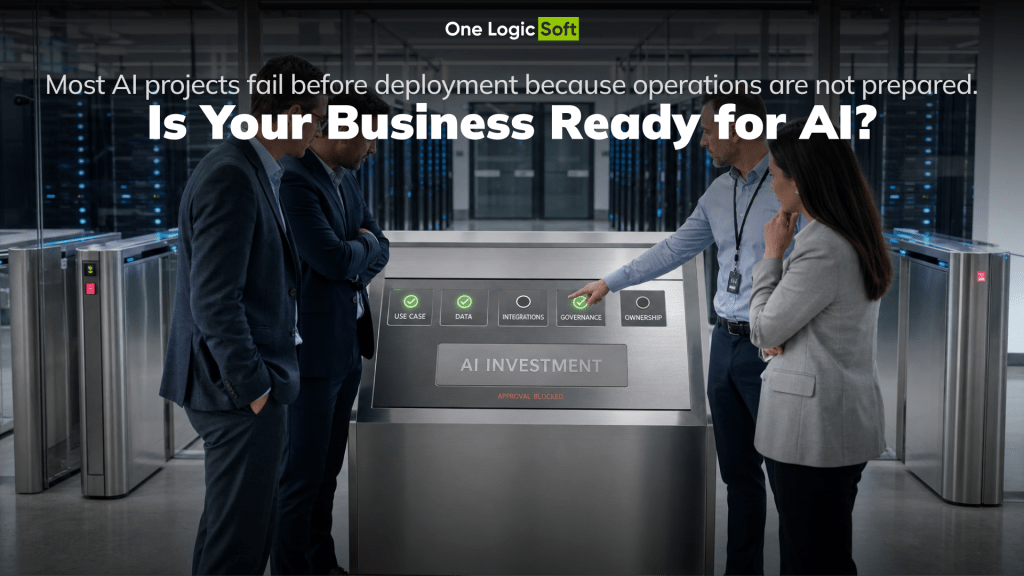
Companies rarely lose money on AI because the model was weak. They lose money because the business was not ready to use AI inside real operations. The data was incomplete, the workflow had no owner, the integration scope was underestimated, security rules appeared too late, or leadership approved a build before defining what success should look like.
That is why an AI readiness audit matters before any serious investment in AI development.
The audit is not a technical formality. It is a commercial checkpoint. It helps a company decide whether the next step should be a pilot, a specification phase, a limited integration project, a workflow redesign, or full AI development.
This matters even more now because many companies are still stuck between experimentation and value capture. McKinsey’s recent research shows that almost all companies invest in AI, but only 1 percent consider themselves mature. Gartner’s AI readiness guidance points in the same direction: readiness depends on data, governance, security, and practical execution, not enthusiasm alone.
What an AI Readiness Audit Should Actually Answer
A useful audit does not ask whether the company likes AI. It asks whether the company can deploy it without creating expensive friction.
The strongest audits answer five business questions.
First, is there a workflow worth improving? Many AI ideas sound impressive in workshops but have weak operational value. If the process is unclear, unstable, rarely used, or already handled well enough, AI may not deserve investment yet.
Second, is the data usable? AI does not need every dataset, but it does need the right data in the right structure with clear ownership, access rules, and acceptable quality. This is where many projects fail before development even starts.
Third, can the systems connect? An AI tool or custom module becomes much less useful when it cannot read CRM records, ERP data, support tickets, document repositories, internal portals, or role-based permissions.
Fourth, is the risk level understood? A content assistant for internal drafts is one thing. An AI workflow that touches customer communication, finance, legal documents, pricing, or operations needs a different level of control.
Fifth, who will own the system after launch? If no team owns prompts, data sources, release updates, user feedback, monitoring, and escalation rules, the solution will degrade even if the first version works.
The Core Audit Areas Before AI Development
Most competitors circle around the same readiness themes, but they often separate them too much. In practice, these areas affect one another.
Business Use Case and ROI Logic
The use case should be specific enough to estimate value and narrow enough to control delivery. “We want an AI assistant” is not a use case. “We want AI to help the operations team classify incoming requests, draft responses, and route exceptions inside the CRM” is.
A readiness audit should test whether the proposed use case improves a real business metric such as cycle time, support load, conversion speed, error rate, case resolution, or analyst productivity.
Data Readiness
This is usually the biggest gap. The question is not whether the company has data. Most do. The question is whether the data is current, accessible, permission-safe, consistent, and tied to the workflow the AI is expected to support.
That includes source systems, document quality, metadata, duplicated records, missing fields, access rights, and refresh logic. This is one reason why work like project specification matters before development starts. A company may think it is buying AI development, when the real blocker is unclear data structure and weak source logic.
Technology and Integration Readiness
AI projects rarely live in isolation. They sit inside business systems. The audit should check APIs, integration constraints, authentication, logging, throughput, latency expectations, and whether the current architecture can support the planned workload.
This is also where companies need to decide whether they are adding AI to an existing platform, adapting current software, or building a custom workflow layer around it.
Governance, Security, and Risk
Deloitte’s enterprise AI research consistently shows that the biggest concerns around AI are governance-related, especially privacy, security, legal exposure, and oversight. That is a serious signal for any company preparing an AI roadmap.
A readiness audit should define who can access what, which actions require human review, what outputs need traceability, what data must stay restricted, how exceptions are handled, and which use cases are too risky for early rollout.
Delivery Ownership and Operating Model
Even technically strong teams can fail here. AI deployment crosses product, operations, security, legal, data, and engineering. If there is no operating model, the project slows down as soon as the first real decision appears.
The audit should clarify who owns the business outcome, who approves scope, who reviews outputs, who maintains the data sources, and who is responsible after release.
AI Readiness Audit Table
| Audit Area | What to Check | Typical Red Flag | Best Next Step |
| Use case | Clear workflow, business metric, user need | Vague idea without measurable outcome | Narrow the use case before estimating |
| Data | Source quality, access, structure, ownership | Missing fields, duplicates, unclear permissions | Data cleanup and source mapping |
| Integrations | APIs, system dependencies, authentication, logs | AI cannot reach the systems that matter | Integration review and architecture planning |
| Governance | Security, privacy, approvals, traceability | Sensitive workflow with no review model | Risk tiering and approval design |
| Operating model | Roles, ownership, release logic, support | No team owns post-launch performance | Define delivery and support responsibility |
The point of this table is simple: a company should not fund AI development before these five areas are understood well enough to reduce delivery risk.
Practical Example Where the Audit Changes the Investment Decision
Take a company that wants AI for internal service operations. Leadership expects faster case handling, lower support pressure, and better response quality. At first glance, this looks like a standard AI assistant project.
The audit changes the picture.
The team finds that knowledge is spread across CRM notes, internal documents, ticket history, and email threads. User permissions differ by department. Some answers can be drafted automatically, but others need approval because they affect customers directly. The current systems can support API access, but logs are inconsistent and document tagging is weak.
Without an audit, the company might approve full AI development too early. After the audit, the better path becomes clear: first improve source structure and permissions, then define approval logic, then build a limited workflow with measurable output.
The audit does not slow the project down. It prevents the wrong project from being funded.
What Companies Miss Most Often
The usual problem is not lack of ambition. It is skipping the boring part that makes production possible.
Many teams move into vendor demos or custom estimates before they answer basic questions about source data, workflow ownership, review logic, or integration depth. Others assume a pilot can prove readiness, when the real blockers appear only after the pilot touches live systems.
That is why the best AI readiness audits are not treated as compliance paperwork. They are treated as investment filters.
A company does not need a huge assessment for every AI idea. But it does need enough structure to avoid funding a use case that looks attractive and breaks on contact with operations.
How One Logic Soft Approaches AI Readiness

For companies moving toward AI development, the best starting point is usually not code. It is preparation.
One Logic Soft uses readiness work to clarify the business case, source systems, roles, integration limits, approval flows, and delivery priorities before AI development starts. This fits early-stage AI initiatives, workflow automation projects, internal assistants, AI search, document processing, and other use cases where the real difficulty sits between departments and systems, not inside a single prompt.
Depending on the maturity of the idea, that work can start with project preparation, continue through Steps of Our Work, and then move into specification or delivery once the scope is clear enough to protect budget and timeline. For companies already close to action, the next step may simply be a structured review and a contact conversation around the use case, systems, and rollout path.
FAQ
What is an AI readiness audit?
An AI readiness audit is a structured review of the business case, data, systems, governance, and ownership needed before investing in AI development. Its purpose is to reduce wasted spend and clarify whether the company is ready for a pilot, a specification phase, or a production project.
When should a company run an AI readiness audit?
The best time is before committing budget to development, platform selection, or a large AI pilot. The audit helps prevent investment in a use case that cannot scale or cannot connect to real operations.
Does every AI project need a full audit?
No. A smaller use case may need only a light readiness review. But any project involving sensitive data, core workflows, customer-facing outputs, or multiple integrations needs a more structured audit.
What usually fails first in AI projects?
Data quality, integration depth, governance, and ownership fail more often than the model itself. Many projects stall because the workflow was not mapped properly or no one defined how the system would work after launch.
What comes after an AI readiness audit?
That depends on the findings. The next step may be data cleanup, process redesign, a limited pilot, project specification, or full AI development. The audit is useful because it helps choose the right next step instead of assuming one too early.


Have a project in mind?
Let's chat
Your request has been accepted!
In the near future, our manager will contact you.
Have a project to discuss?

Have a partnership in mind?