AI for B2B E-commerce Product Data, Pricing Rules, Search, and Partner Portals
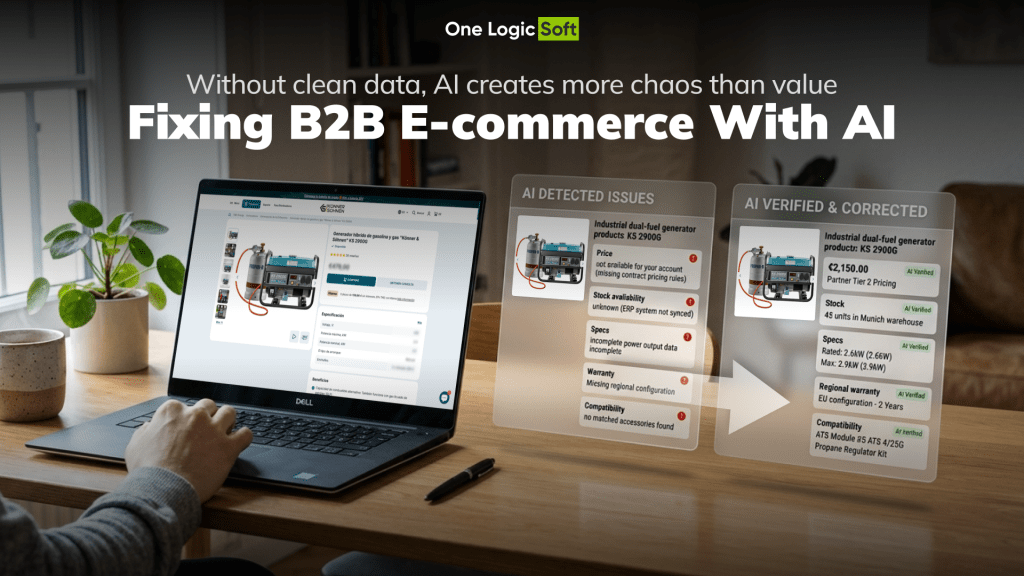
B2B e-commerce starts breaking when the platform cannot answer basic commercial questions. A partner logs in and sees the wrong product range. A regional team updates pricing manually. Search cannot match technical queries with the right items. Sales receives repeated questions about availability, specs, documents, discounts, and reorders.
AI can help with these problems, but only when it is connected to clean product data, pricing rules, account logic, and operational workflows. Without that foundation, AI becomes another layer of guesswork on top of an already fragmented commerce system.
For B2B companies, the best AI use cases are rarely flashy. They support the work that already affects sales: catalog accuracy, partner-specific pricing, product discovery, localization, reorder flows, quote preparation, and account-based buying.
Why AI in B2B E-commerce Starts With Data
A B2B buyer is not shopping like a consumer. They may search by model number, technical specification, spare part, compatibility, voltage, delivery region, account discount, warranty condition, or reorder history. The platform needs to connect that intent with real business data.
AI can support this process only when the product catalog has structure. Product names, attributes, variants, documents, categories, prices, stock, and regional availability need clear ownership. If this data is inconsistent, AI search and AI assistants will return answers that sound confident but create operational risk.
This is why AI-ready data architecture matters before adding AI to B2B commerce. The platform needs a trusted source for product data, pricing, customer access, and integrations before AI can improve anything meaningful.
Product Data Is the Core of B2B AI
Product data controls what buyers can find, compare, trust, and order. In B2B commerce, this includes more than titles and descriptions. The system needs technical attributes, compatibility logic, documents, certificates, spare parts, regional versions, and product relationships.
AI can help teams find missing attributes, detect duplicate products, suggest better product grouping, support translation workflows, and improve search relevance. But final control should stay with product, sales, or operations teams.
A practical product data setup should answer questions like:
- Which products belong to this partner catalog?
- Which accessories or parts match this item?
- Which documents should be visible in this region?
- Which product replaces an older model?
- Which attributes are missing or written inconsistently?
For manufacturers, distributors, and multi-market commerce teams, these questions affect sales directly. If product data is weak, AI will not fix commerce. It will expose the weak points faster.
Pricing Rules Need Human Approval
Pricing is one of the most useful and risky AI areas in B2B e-commerce. Many B2B companies manage different prices by partner tier, region, volume, contract, currency, stock level, or payment terms.
Shopify’s B2B features show how much commercial logic modern B2B commerce needs: catalogs, custom pricing, product availability control, volume pricing, quantity rules, payment terms, customer accounts, reorders, and integrations with ERP or other systems.
AI can support pricing teams by flagging unusual margin changes, outdated partner prices, regional mismatches, or products that need review. But AI should not change prices on its own in most B2B setups.
A safer model is simple:
- AI finds pricing issues or opportunities.
- Sales, finance, or category managers review them.
- Approved changes move into the commerce system.
- The platform logs what changed, who approved it, and which accounts were affected.
This keeps speed without losing commercial control.
Search Should Understand Technical Buying Intent
Search is one of the fastest ways to see whether a B2B platform is working. If buyers cannot find the right product, they return to email, calls, spreadsheets, and manual sales support.
AI-assisted search can help when buyers type technical phrases, partial SKUs, old product names, use cases, or compatibility questions. It can connect search intent with product attributes, documents, categories, and account permissions.
For example, a partner may search for a generator by use case, a spare part by an old model, a product manual in another language, or a compatible accessory for an existing item. A basic keyword search can miss that intent. AI search can match it better, but only if the underlying catalog is structured.
Search improvement should be measured by practical signals:
- fewer zero-result searches
- better product discovery
- fewer routine product questions for sales
- higher partner portal usage
- more completed reorders
These metrics show whether AI is reducing friction rather than adding another feature to the interface.
Partner Portals Are the Best Place for Practical AI
A B2B partner portal should reduce repeated sales work. Partners need account-specific catalogs, pricing, order history, documents, reorder options, quote requests, and access to relevant support information.
AI can improve a partner portal when it helps buyers complete common actions:
- find the right product or document
- repeat a previous order
- check account-specific pricing
- prepare a quote request
- compare compatible products
- route complex cases to the right sales person
This is where AI becomes useful for revenue operations. It does not replace the relationship between the company and its partners. It removes routine friction from that relationship.
Mini-Case Könner & Söhnen Style Multi-Market Commerce
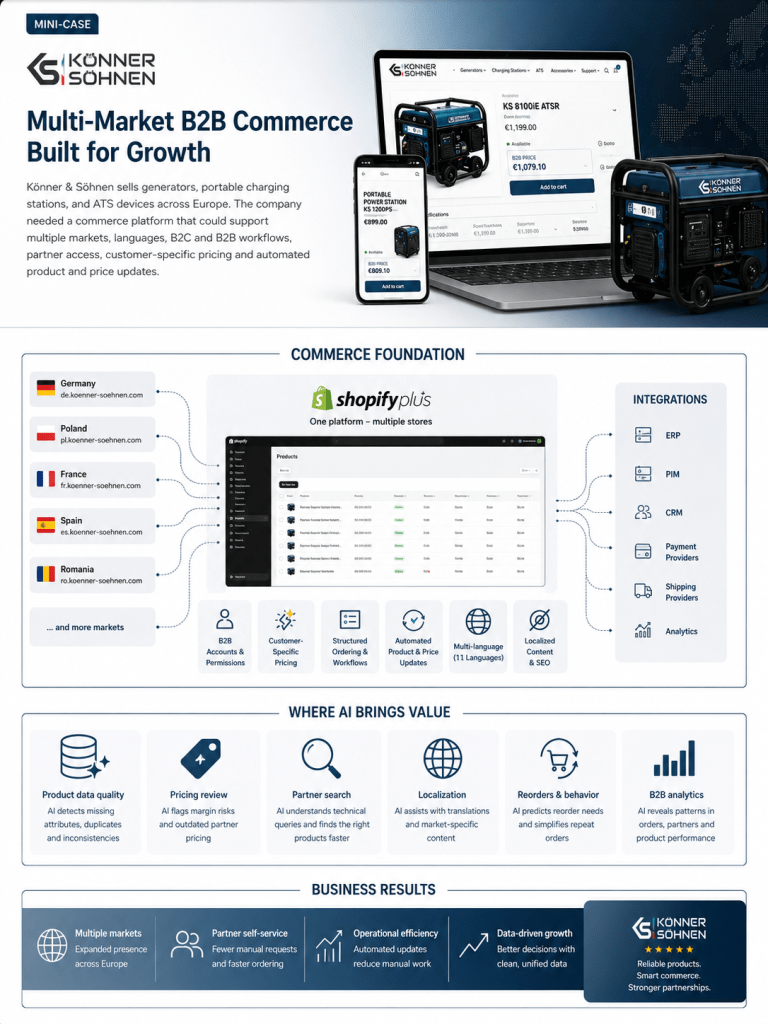
The Könner & Söhnen Shopify Plus Commerce Platform shows the type of foundation B2B AI needs.
Könner & Söhnen sells generators, portable charging stations, and ATS devices across European markets. The commerce setup had to support regional stores, multiple languages, B2C and B2B workflows, partner access, structured ordering, customer-specific pricing, and automated product and pricing updates.
This is exactly the type of environment where AI can create real value later. Not as a generic chatbot, but as support for product data quality, pricing review, localized content, partner search, reorder behavior, and B2B analytics.
| Commerce Area | AI Can Help With | Business Control Needed |
| Product data | Finding missing attributes, duplicates, inconsistent names, weak descriptions | Product team approves catalog changes |
| Pricing | Flagging margin risks, outdated rules, unusual regional differences | Sales or finance approves changes |
| Search | Matching technical queries with products, documents, accessories, and old model names | Product team validates search logic |
| Localization | Drafting market-specific content and translation variants | Regional teams review final content |
| Partner portal | Supporting reorders, account questions, quote preparation, and document search | Sales handles exceptions and negotiations |
This is the right order of thinking. AI follows commerce logic. It should not define it from scratch.
What to Fix Before Adding AI
B2B teams should avoid adding AI on top of broken workflows. A chatbot will not solve disconnected pricing. AI search will not solve missing product attributes. Automated content will not solve unclear regional ownership.
Before implementation, the team should review:
- product data quality
- pricing ownership
- partner roles and permissions
- ERP or CRM integration points
- search logs and failed queries
- localization workflow
- quote and reorder processes
- approval rules for commercial changes
This review helps separate useful AI from expensive decoration.
How One Logic Soft Approaches B2B E-commerce AI
One Logic Soft treats AI in B2B commerce as part of platform planning, not as a standalone feature. The work starts with data sources, product structure, pricing logic, partner workflows, integrations, user roles, QA, and release priorities.
This fits companies that need more than standard storefront setup. B2B e-commerce often requires custom software development around Shopify Plus, ERP, CRM, partner portals, pricing workflows, localization, dashboards, or internal automation.
For a company with a live commerce platform, the safer first step is an audit of product data, pricing rules, search behavior, and partner workflows. For a company planning a rebuild, these points should be included before development starts.
FAQ
What is AI for B2B e-commerce?
AI for B2B e-commerce means using AI to support product data, pricing review, search, partner portals, localization, quote workflows, reorders, and sales operations. It works best when connected to trusted business data and clear approval rules.
What is the best first AI use case for a B2B store?
The best first use case depends on the biggest operational problem. Large catalogs often benefit from product data cleanup or AI search. Partner-heavy businesses may see better results from portal support, reorder flows, or document search.
Can AI manage B2B pricing automatically?
AI can support pricing review, but fully automatic pricing is risky for many B2B companies. Partner contracts, margins, regions, payment terms, and sales relationships often need human approval before prices change.
Why is product data so critical for B2B AI?
Product data controls search, recommendations, compatibility, documents, localization, and partner visibility. If the data is incomplete or inconsistent, AI will give weak results no matter how advanced the tool is.
How can a company measure AI impact in B2B commerce?
Useful metrics include fewer failed searches, fewer routine sales requests, faster catalog updates, fewer pricing corrections, higher reorder completion, faster quote preparation, and stronger partner portal usage.


Have a project in mind?
Let's chat
Your request has been accepted!
In the near future, our manager will contact you.
Have a project to discuss?

Have a partnership in mind?