What Software Teams Need Before Moving from AI Pilot to Production
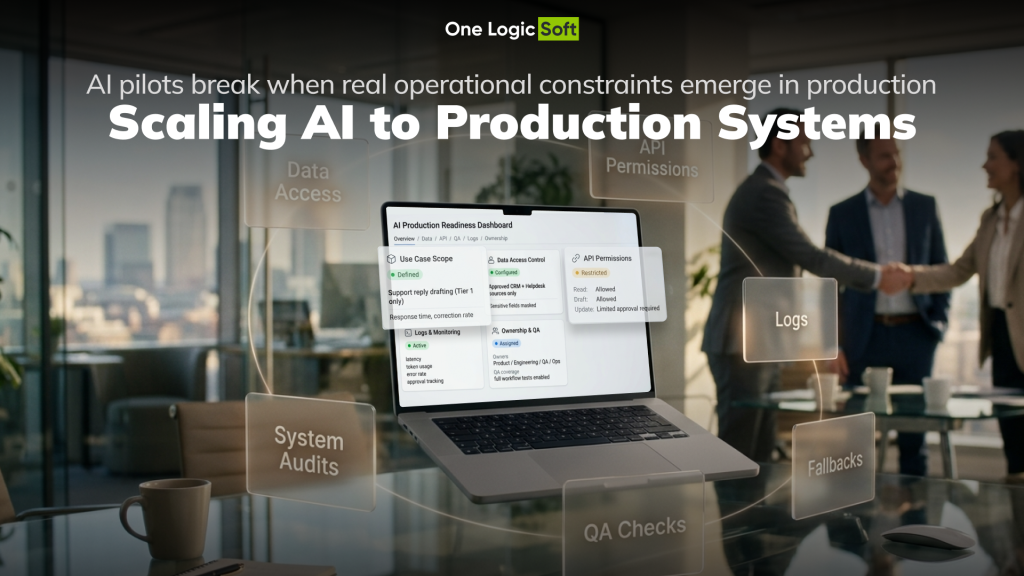
An AI pilot can look convincing in a controlled demo and still be unsafe for production. The model answers prepared examples. The interface feels useful. The business sees possible efficiency gains. Then the real questions appear: who gives the system access to live data, which API actions it can take, what gets logged, who approves uncertain outputs, and what happens when the answer is wrong.
That gap is where many AI initiatives lose momentum. Gartner reported in June 2025 that over 40% of agentic AI projects may be canceled by the end of 2027 due to rising costs, unclear business value, and weak risk controls. A pilot proves technical possibility. Production readiness proves that the workflow can run inside real operations. Gartner
For CTOs and product leaders, the move from AI pilot to production is a software delivery question. It needs scope, API rules, data boundaries, QA, logs, fallback flows, ownership, and a staged release plan.
Why AI Pilots Break Down Before Production
A pilot answers one question: can this AI workflow work under limited conditions? Production asks a harder question: can the business run this workflow every day with real users, real records, external systems, access limits, failures, audits, and support requests?
In a pilot, the team may work with exported documents, sample tickets, copied CRM records, synthetic transactions, mock APIs, or a sandbox dataset. That helps validate the idea. It does not prove that the system is ready to read live data, update operational systems, or influence customer-facing work.
Google Cloud’s MLOps guidance makes the same point from an engineering angle: production ML systems depend on surrounding components such as configuration, data verification, testing, resource management, serving infrastructure, and monitoring, not only the model itself. Google Cloud
The production gap is usually found around the model:
- Data access: which systems, fields, and documents the AI may read.
- API permissions: which actions are read-only, draft-only, approval-based, or automated.
- Logs: what the team needs for audit, debugging, quality review, and cost control.
- Fallback flows: how the system reacts to missing data, low confidence, timeouts, and failed API calls.
- Ownership: who owns defects, incidents, access changes, prompt updates, and workflow changes after release.
This is why AI production readiness belongs inside project preparation, not after the pilot has already been approved.
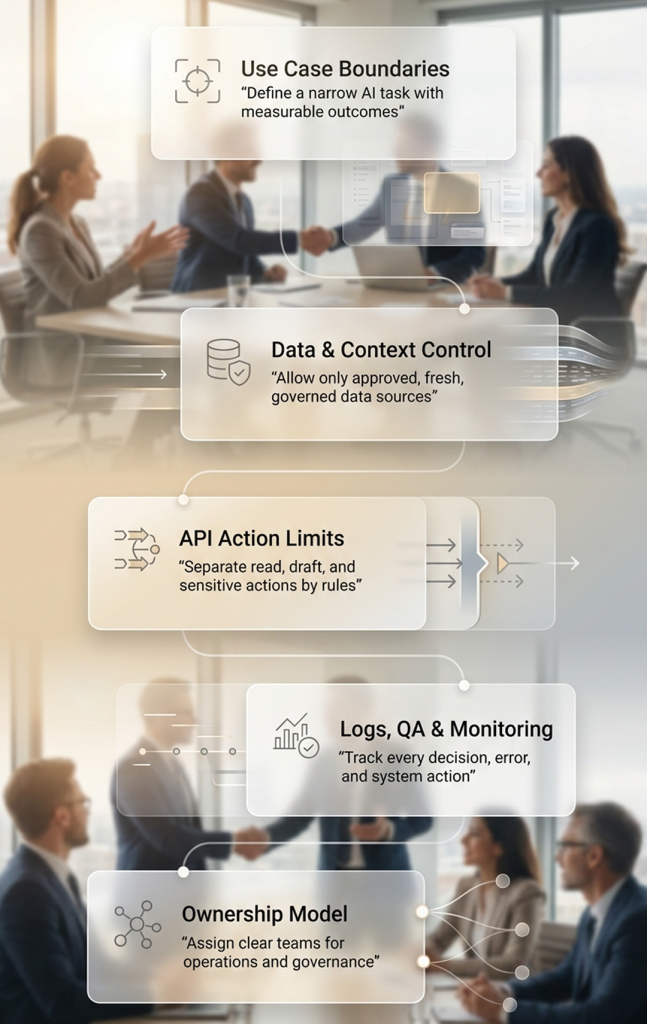
Production Readiness Framework for AI Software Teams
A practical readiness review covers five layers: use case boundaries, data access, API action limits, QA and monitoring, and ownership after launch.
Use Case Boundaries
A production AI feature needs a narrow job. Broad goals such as “improve support,” “automate operations,” or “make the CRM smarter” are too loose for scaling.
Stronger production use cases look like this:
- Draft support replies from approved knowledge sources.
- Classify incoming orders by urgency and missing data.
- Extract invoice fields, then send uncertain cases to review.
- Summarize account activity before a sales call.
- Detect logistics exceptions from route, status, and timing data.
Each use case needs a clear metric: review time, correction rate, escalation rate, manual updates removed, first-response speed, or cost per completed workflow.
Data and Context Control
AI systems fail when they receive stale records, missing fields, duplicated documents, or unrestricted internal data. A model that performs well on clean pilot data can weaken once it reads the real CRM, ERP, OMS, helpdesk, or document base.
Before scaling, the team needs to define:
- approved data sources and data owners
- access rights by role
- retrieval rules and context freshness
- redaction for sensitive fields
- retention rules for prompts, outputs, and logs
- data quality checks before release
This is part of project specification, data flow design, permissions, and acceptance criteria.
API Access and Action Limits
AI becomes riskier when it can act through APIs. Reading a knowledge base is one risk level. Updating a CRM field is another. Canceling an order, approving a refund, changing a shipment, or sending a customer message requires stronger control.
| Action class | Example | Production rule |
| Read-only | Retrieve ticket history, product data, booking details | Allow with role-based access and logging |
| Draft action | Create a reply, summary, task note | Store as draft until approval |
| Limited update | Add a tag, fill a field, change low-risk status | Allow under thresholds, rules, and rollback logic |
| Sensitive update | Refund, cancellation, pricing change, clinical note | Require human approval and audit trail |
| External communication | Email, SMS, customer reply, partner update | Use approval flow, message history, and rate limits |
If the team cannot classify AI actions, it is too early to give the system broad production access.
Logs, QA, and Monitoring
AI logs are not only technical traces. They are product evidence. They show which input was used, which model ran, which retrieval sources were selected, which action was proposed, which user approved it, and where the flow stopped.
A production-ready AI system needs logs for:
- debugging wrong outputs
- audit and approval history
- correction rate, false positives, retries, and fallback usage
- model-call volume, token usage, latency, and cost per workflow
QA should test the full workflow: user request, retrieval, AI output, human review, API action, logging, fallback, and post-release monitoring. This connects AI scaling directly with QA in product development.
Readiness Matrix: From Demo to Production
Use this matrix before giving an AI pilot production data, API permissions, or direct user impact.
| Readiness area | Pilot-level answer | Production-ready answer |
| Use case | “The model can answer support questions.” | “The system drafts replies for Tier 1 tickets from approved sources, then routes them to agents for approval.” |
| Data | “We uploaded sample documents.” | “The system retrieves approved sources, checks freshness, masks restricted fields, and logs the source used.” |
| API access | “The AI connects to CRM.” | “CRM access is read-only for account history, draft-only for notes, and approval-based for customer-facing updates.” |
| Quality | “The pilot looked accurate.” | “The team tracks acceptance rate, correction rate, false positives, escalation rate, latency, and cost.” |
| Fallback | “A human can step in.” | “Low-confidence outputs, missing fields, API errors, and sensitive actions follow defined fallback rules.” |
| Ownership | “The AI team monitors it.” | “Product, engineering, QA, operations, and support own named parts of quality, access, incidents, and roadmap.” |
The matrix turns the go-live conversation from opinion into criteria.
Mini-Case: AI Support Assistant Moving Past the Pilot
A B2B company tests an AI assistant for customer support. In the pilot, the assistant summarizes tickets, drafts replies, and finds relevant knowledge base articles. Support agents like the summaries, and managers see shorter response preparation time.
Then the production review changes the scope.
The pilot used exported tickets and a static knowledge base. Production requires live helpdesk data, customer account status from CRM, subscription details from billing, and product availability from an internal system. Full access would be too broad.
The production design becomes stricter:
- The assistant reads only approved customer, ticket, subscription, and help article data.
- It creates reply drafts, not direct replies.
- It shows source references inside the agent screen.
- It cannot promise refunds, contract changes, delivery dates, or legal terms.
- It logs the prompt, sources, output, agent edits, approval, and send time.
- It routes uncertain cases to senior support.
The AI feature becomes less flashy, but far more usable. It no longer behaves like a demo. It becomes part of a controlled software workflow.
What to Prepare Before Scaling an AI Pilot
Before moving from pilot to production, software teams should prepare a short readiness package. It does not need heavy documentation. It needs clear answers to the questions that decide risk.
- Use case scope Define the exact job, users, allowed actions, and actions outside scope.
- Business metric Pick one or two measurable outcomes, such as shorter handling time, lower correction rate, fewer manual updates, or cleaner routing.
- Data map List data sources, owners, access rights, update frequency, restricted fields, and quality issues.
- API permission map Separate read-only actions, draft actions, low-risk updates, sensitive updates, and external messages.
- Evaluation set Prepare test examples, edge cases, approved answers, rejected answers, and known failure patterns.
- Fallback rules Define when the system stops, asks for review, retries, escalates, or refuses to act.
- Logging plan Decide what gets logged for input, retrieval, output, approval, action, error, cost, and incident review.
- Ownership model Name the business, technical, QA, data, and operations owners.
This checklist fits naturally into project planning for web and mobile apps when AI is part of a broader product roadmap.
How One Logic Soft Approaches AI Production Readiness
One Logic Soft treats AI scaling as part of software product delivery, not as a model demo. The team reviews the business goal, maps the workflow, defines access boundaries, checks integration risks, prepares acceptance criteria, connects QA with release planning, and clarifies ownership after launch.
That approach fits AI features inside custom software development projects where the product depends on roles, business rules, external systems, operational data, and long-term ownership.
The same delivery logic appears in One Logic Soft’s work with operational platforms. The UVK order management system shows how software tied to real operations needs status logic, document handling, routing, integrations, support, and continuous improvement. AI features require the same control, plus extra care around data, outputs, and automated actions.
For a company with a promising pilot, the next step is usually not a larger demo. The safer next step is a readiness review: what systems the AI needs, which actions it can take, what QA will test, which logs are needed, and who owns production behavior. One Logic Soft can support that work through preparation, specification, QA review, or a wider delivery plan based on How We Manage Projects.
FAQ
What is the difference between an AI pilot and an AI production system?
An AI pilot tests whether a use case works under limited conditions. A production system runs inside real workflows with live data, access controls, monitoring, fallback rules, QA coverage, and operational ownership.
Why do AI pilots stall before production?
They stall when the pilot proves model capability but skips business value, data access, API permissions, security, QA, logging, and ownership. The demo works, but the business is not ready to operate it safely.
What should CTOs check before giving AI access to APIs?
They should classify each action by risk: read-only, draft, limited update, sensitive update, and external communication. Each class needs separate permissions, logs, approval rules, and rollback logic.
What logs are needed for a production AI feature?
Useful logs include input, retrieved sources, model output, user edits, approval, final action, API response, error state, latency, and cost. The exact set depends on workflow risk.
Does every AI system need human review?
No. Low-risk internal actions may run with limited automation after testing. Sensitive actions, customer-facing communication, financial changes, regulated data, and high-impact decisions need review or approval rules.
Can One Logic Soft work with an existing AI pilot?
Yes. One Logic Soft can review an existing pilot, map the production gaps, define access and QA rules, prepare a delivery plan, and support the move from prototype to production-ready software.


Have a project in mind?
Let's chat
Your request has been accepted!
In the near future, our manager will contact you.
Have a project to discuss?

Have a partnership in mind?