How to Decide What to Automate First in AI Workflow Automation
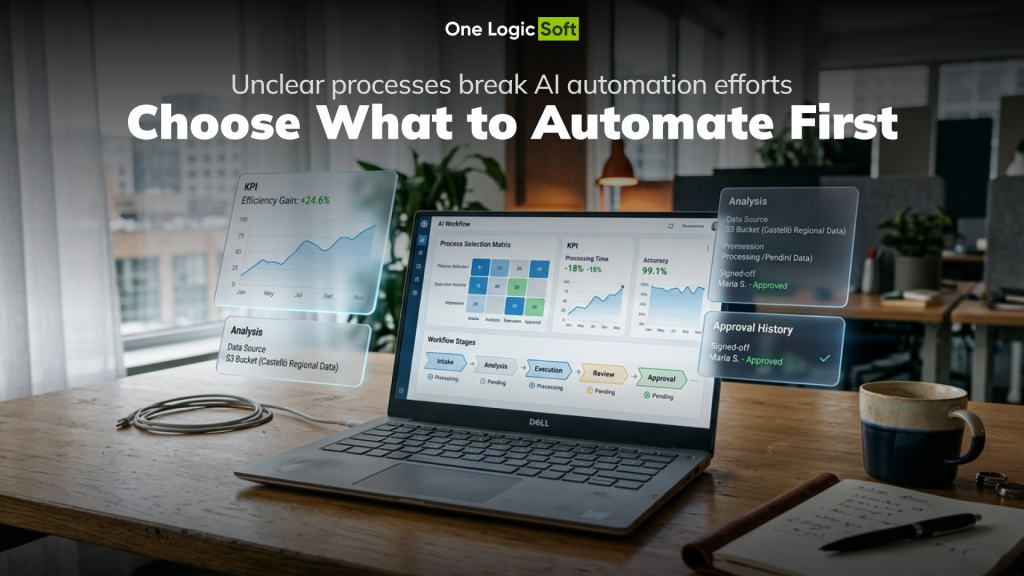
A company rarely needs AI in every process at once. It needs one painful workflow selected with care, mapped with real users, connected to clean data, tested against edge cases, and measured after release.
That is where many AI workflow automation projects lose focus. A team sees repetitive work, buys a tool, connects it to a few systems, and expects productivity to rise. The demo looks promising. The production result is weaker: missing data, unclear approvals, low user trust, broken handoffs, and no clear owner for what happens when the AI output is wrong.
The business pressure is real. McKinsey’s 2025 workplace AI research reports that 92% of executives expect to increase AI spending over the next three years, yet only 1% describe their companies as mature in AI deployment. Gartner gives a sharper warning for agentic AI: over 40% of agentic AI projects could be canceled by the end of 2027, mainly due to rising costs, unclear value, and weak risk controls.
This article explains how to choose the right workflow for AI automation before development starts, which signals show that a process is ready, and what a software team needs to define before moving from idea to release.
Why AI Workflow Automation Goes Wrong When Teams Start With Tools
The wrong starting point is: “Which AI tool can automate this?”
The better starting point is: “Which business workflow creates repeated cost, delay, risk, and manual effort that software can measure and control?”
AI workflow automation works best when the company treats AI as part of a broader software system. The model is one component. Around it sit forms, permissions, data sources, integrations, audit logs, dashboards, notifications, fallback rules, QA checks, and support routines.
That is why AI automation fits naturally into custom software development when the process touches internal tools, CRM, ERP, order management, inventory, documents, customer portals, partner portals, and staff dashboards. A generic AI assistant can answer a question. A production workflow has to move work from one state to the next without losing ownership.
Most weak AI automation ideas share the same pattern:
- The workflow is not mapped from start to finish.
- The data source is incomplete, outdated, duplicated, inaccessible.
- Teams disagree on who approves the AI output.
- Exceptions are more common than the standard path.
- No one defines what success means after release.
A workflow that looks repetitive from the outside can hide legal, financial, operational, and customer-facing risk. The selection process needs to expose that risk before a budget is approved.
How to Decide Which Workflow Should Be Automated First
A good AI automation candidate sits at the intersection of measurable business value, repeatable process logic, available data, and acceptable risk. The decision cannot depend on enthusiasm alone.
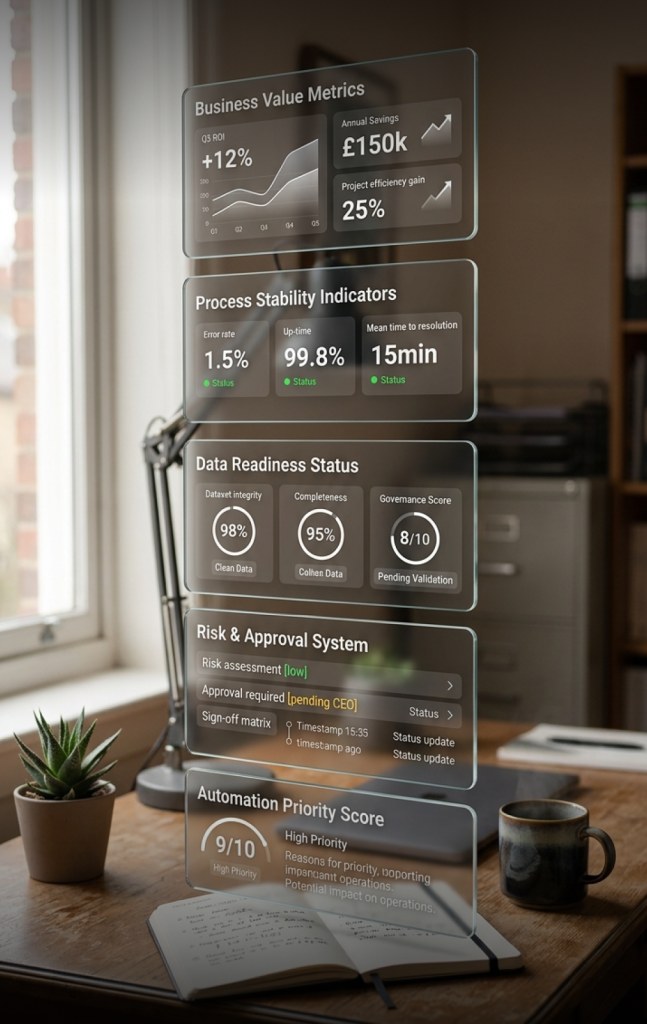
Business Value: Which Bottleneck Costs the Team Money Every Week?
Start with recurring friction that can be counted. Good candidates appear in places where employees spend hours on classification, document review, status updates, routing, report preparation, customer replies, product content checks, invoice matching, lead qualification, internal approvals, scheduling, claims triage, inventory checks, and exception sorting.
The question is not whether the work is boring. The question is whether the delay affects revenue, service speed, operational cost, customer experience, compliance, data quality, sales follow-up, stock accuracy, dispatch planning, support workload, management visibility.
A workflow has stronger automation potential when the company can define a baseline:
- average processing time
- number of cases per week
- error rate
- handoff delays
- cost per task
- missed SLA count
- team hours spent on rework
- customer wait time
Without a baseline, AI value turns into opinion. With a baseline, the team can compare the workflow before and after release.
Process Stability: Does the Workflow Follow a Clear Path?
AI handles variation better than simple rule-based automation, but a chaotic process still needs structure. The team needs to know where the workflow starts, what data enters the system, which states the task passes through, which roles take action, what counts as completion, and which exceptions stop the flow.
This is where project planning for web and mobile apps protects the budget. Before AI logic is discussed, the team maps the workflow in normal language: request received, data checked, classification completed, human review triggered, output approved, system updated, notification sent, task closed.
If the company cannot describe the workflow without AI, it is too early to automate it with AI.
Data Readiness: Can the System Trust the Inputs?
AI workflow automation depends on the quality of the inputs. A model can summarize a ticket, classify a request, suggest a route, flag a risky invoice, draft a customer reply, detect a mismatch, and recommend the next action. It cannot fix unclear data ownership by itself.
Before development starts, the team needs to answer several questions:
- Which system is the source of truth?
- Are records duplicated across CRM, ERP, warehouse tools, spreadsheets, and internal portals?
- Can the workflow access the required fields through API?
- Are permissions clear for staff, managers, partners, vendors, and clients?
- Are historical cases clean enough to train, tune, validate, compare outputs?
- What data cannot be exposed to the model?
Many AI workflow projects turn into integration projects. That is why earlier work on integration project timeline risks matters for AI planning as much as for classic software delivery.
Risk and Approval: Where Does a Human Stay in the Loop?
The safest automation plan does not remove people from every decision. It removes unnecessary manual work around the decision.
For low-risk workflows, AI can classify, route, draft, enrich, summarize, and update records with limited review. For higher-risk workflows, AI needs approval gates. This is common in finance, healthcare, logistics exceptions, insurance claims, B2B pricing, inventory allocation, compliance checks, and customer-facing messages.
A clear approval design defines:
- which actions AI can take alone
- which outputs need human review
- which roles approve changes
- what gets logged
- what triggers escalation
- how users override the suggestion
- how the system learns from corrections
The goal is not full autonomy by default. The goal is controlled automation with measurable output, clear responsibility, and practical rollback.
AI Workflow Automation Priority Matrix
Use the matrix below to choose the best starting point. The strongest first project is rarely the flashiest one. It is the workflow with clear value, clean enough data, low-to-medium risk, and visible ownership.
| Workflow candidate | Automation fit | Good signals | Main risk | Best first step |
| Support ticket triage | Strong | High volume, repeated categories, clear routing rules | Wrong routing increases response time | Map categories, escalation rules, and SLA impact |
| Invoice matching | Medium to strong | Structured documents, known vendors, recurring checks | Financial errors need review | Start with AI-assisted flagging, not full approval |
| Logistics exception handling | Strong | Repeated status problems, dispatcher workload, tracking data | Bad data from external systems affects decisions | Define exception states and human approval points |
| Product content enrichment | Strong | Large catalog, repeated attributes, multilingual needs | Inaccurate descriptions affect search and trust | Set field rules, review thresholds, and quality checks |
| B2B pricing approval | Medium | Clear discount rules, account tiers, order history | Pricing errors affect margin and partner trust | Keep AI as recommendation layer with manager approval |
| Healthcare appointment routing | Medium | Clear service types, staff schedules, patient requests | Privacy and safety rules increase review needs | Separate scheduling assistance from clinical decisions |
| Sales lead scoring | Strong | CRM data, conversion history, defined sales stages | Biased scoring can hide good leads | Compare AI scores with historical outcomes |
| Inventory replenishment alerts | Medium to strong | Stock data, sales velocity, supplier timing | Demand swings and delayed sync distort recommendations | Connect stock, sales, and supplier data before AI logic |
What Teams Usually Miss Before Building AI Workflow Automation
AI workflow automation fails less from weak prompts and more from missing product decisions. The model becomes the visible part of the project, but the operational work sits underneath.
One missed decision is ownership. If AI drafts a reply, who owns the reply before it reaches the customer? If AI flags a shipment exception, who confirms the status? If AI recommends a stock transfer, who approves the impact on another warehouse?
Another common gap is exception design. Teams map the happy path and skip rare cases, then discover that rare cases consume most of the support time. A logistics workflow needs damaged goods, missing documents, address mismatch, driver delay, warehouse delay, partial delivery, and customer refusal states. A retail workflow needs out-of-stock, payment failure, loyalty mismatch, duplicate order, return request, price override, and store pickup exceptions.
QA is often reduced to “does the AI answer look right?” That is too weak for production. QA in product development for AI automation needs test cases for standard flows, edge cases, permissions, integration failures, wrong inputs, prompt injection risks, output accuracy, audit logs, and manual overrides.
The final gap appears after release. AI workflow automation needs monitoring. The team needs to see how often the system routes tasks correctly, when users override outputs, where data errors occur, which integrations fail, how much time is saved, and which cases still return to manual work.
Mini-Case: Choosing Automation Order in a Logistics Operation
Take a logistics operation with order intake, document handling, dispatch coordination, tracking statuses, customer updates, and accounting handoffs. The temptation is to automate customer communication first, since it is visible and easy to demo.
A safer starting point may be exception classification. Dispatchers lose time sorting late arrivals, document gaps, route changes, warehouse delays, and missing confirmations. AI can group incoming messages, match them to order statuses, suggest the next action, and prepare updates for review. Human dispatchers stay in control, but the system removes repeated sorting and status preparation.
This type of thinking matches the operational nature of the UVK order management system, where software value comes from connected workflows, statuses, documents, integrations, and staff coordination. The AI layer only makes sense when the underlying workflow is visible.
Retail has the same pattern. In a flow similar to the Scan&Go mobile self-checkout case, AI should not be added before the core shopping path is reliable. Product recognition, personalized offers, fraud signals, stock suggestions, and support prompts depend on checkout logic, cart state, payments, loyalty rules, and store data.
B2B commerce adds another layer. In a setup like the Könner & Söhnen Shopify Plus commerce platform, AI can support product data, regional content, partner pricing, stock checks, and dealer communication only after business rules and data ownership are defined.
How One Logic Soft Approaches AI Workflow Automation
One Logic Soft treats AI workflow automation as a software planning task, not a tool selection task.
The team starts by clarifying the business goal, mapping the workflow, separating standard cases from exceptions, reviewing systems and data sources, and defining what belongs in the first release. This connects AI planning with project specification, integration review, role logic, QA planning, and post-launch ownership.
For many projects, the first release does not need a fully autonomous AI agent. A stronger starting point is an assisted workflow: AI classifies, drafts, recommends, flags, summarizes, enriches, and prepares. People approve the output, corrections are logged, and the system gains a measurable feedback loop.
After the workflow proves value, the next releases can expand the automation level, connect extra systems, add dashboards, refine model behavior, and move selected low-risk actions closer to automatic execution.
Checklist: What to Define Before Automating a Workflow With AI
- Business outcome: name the cost, delay, error, risk, quality problem, revenue leak that the workflow needs to reduce.
- Workflow map: document the start point, roles, states, handoffs, approvals, exceptions, completion point.
- Baseline metrics: record task volume, processing time, error rate, manual hours, SLA misses, rework.
- Data sources: define systems of record, data fields, access rights, API readiness, data quality issues.
- AI role: decide whether AI classifies, drafts, recommends, routes, summarizes, validates, predicts, acts.
- Human control: define review points, approval roles, override rules, escalation paths, audit logs.
- Integration scope: list CRM, ERP, POS, OMS, WMS, email, documents, payments, maps, analytics, internal tools.
- QA plan: prepare test cases for normal paths, edge cases, wrong inputs, permission errors, integration failures.
- Release model: define first release, pilot users, success metrics, support owner, monitoring dashboard.
- Next-step logic: decide what has to improve before the workflow can move from assisted automation to higher autonomy.
When One Logic Soft Fits the Project
One Logic Soft fits AI workflow automation projects where the automation depends on real business operations, not a standalone AI demo. This includes platforms with multi-role workflows, internal tools, customer portals, partner portals, CRM or ERP connections, document flows, dashboards, data rules, QA needs, and long-term support.
The practical next step is a workflow review: define the process, check systems and data, choose the first automation candidate, and turn the idea into a scoped release plan. For projects with unclear scope, a planning stage works better than jumping straight into development. For projects with defined goals and existing systems, the team can align scope with software development cooperation models that fit the risk level and delivery stage.
FAQ
What is AI workflow automation?
AI workflow automation uses AI inside a business process to classify information, draft outputs, route tasks, recommend actions, detect issues, enrich records, and reduce manual work. It differs from a simple chatbot, since the AI is connected to process states, systems, users, approvals, and measurable outcomes.
How do you choose the first workflow to automate with AI?
Choose a workflow with high volume, measurable cost, repeated decisions, clear ownership, available data, and manageable risk. Avoid starting with the most complex workflow if the data is weak, approvals are unclear, and exceptions are not mapped.
Which workflows are poor candidates for early AI automation?
Poor candidates include rare workflows, chaotic processes, sensitive decisions without review logic, tasks with unclear source data, processes owned by several teams without agreement, and workflows where success cannot be measured.
Is AI workflow automation the same as RPA?
No. RPA follows predefined steps. AI workflow automation can classify, interpret, summarize, recommend, and handle variation. Many enterprise workflows need both: rule-based automation for stable steps and AI for interpretation-heavy work.
Does every workflow need an AI agent?
No. Some workflows need a rules engine, integration cleanup, better forms, dashboards, notifications, data validation, or admin tools before AI adds value. Gartner notes that many use cases presented as agentic AI do not need agentic implementation.
What data is needed for AI workflow automation?
The team needs reliable records, clear systems of truth, accessible fields, permission logic, historical examples, documented exceptions, and a way to compare AI outputs against business results. Weak data turns automation into guesswork.
How can AI workflow automation be tested after release?
Testing continues after launch through output review, user overrides, false-positive tracking, integration error logs, permission checks, response time monitoring, SLA impact, and comparison with baseline metrics.
Can One Logic Soft help define the right AI automation candidate?
Yes. One Logic Soft can review business workflows, systems, data sources, integration points, user roles, QA risks, and release scope before development. The result is a clearer automation plan tied to measurable business value.


Have a project in mind?
Let's chat
Your request has been accepted!
In the near future, our manager will contact you.
Have a project to discuss?

Have a partnership in mind?